Introduction
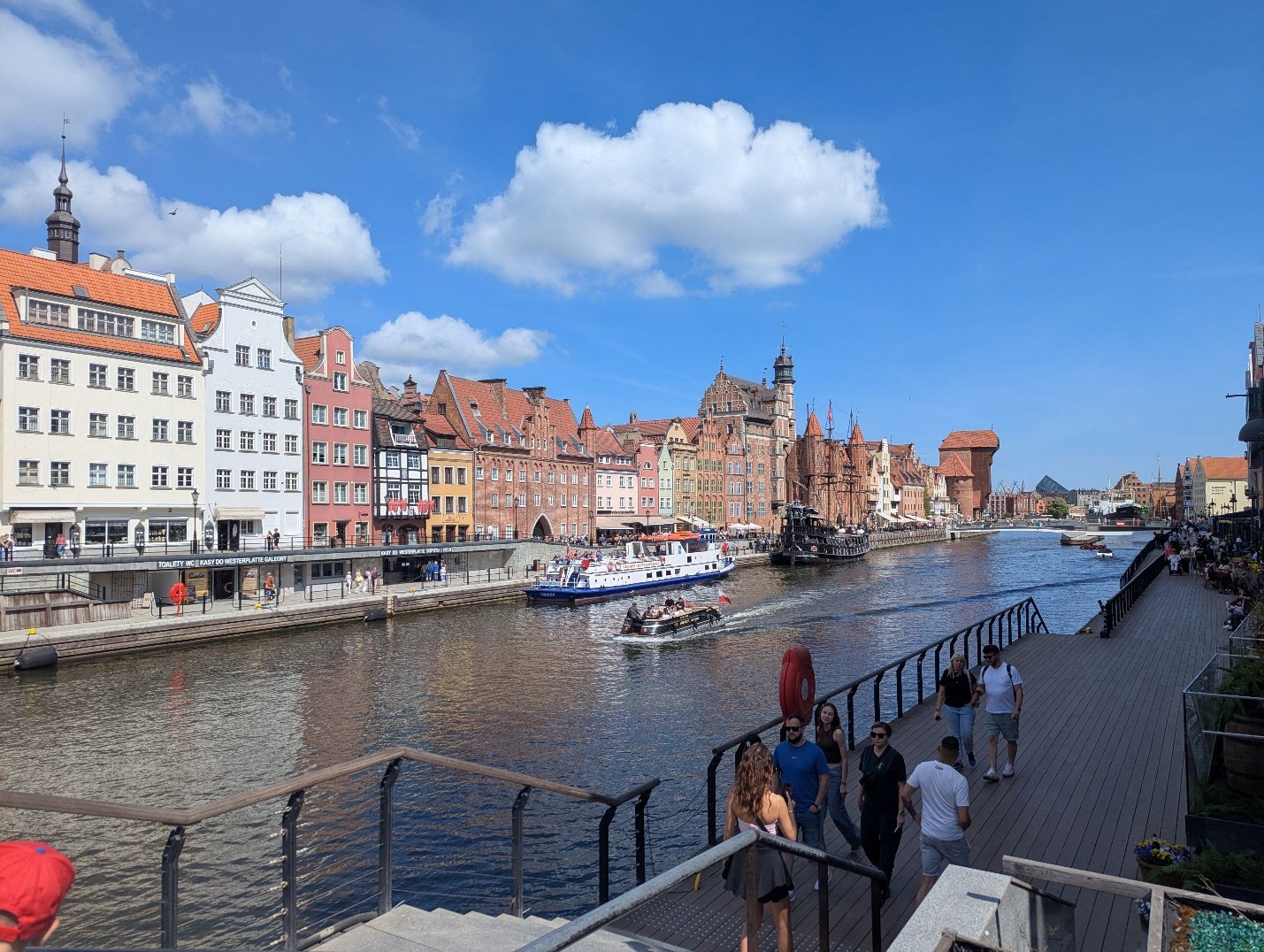
My daughter Rachel was on a quest (since achieved) to visit 40 countries by the age of 40, so we visited Gdansk, Poland during the long weekend in May. I would like to take credit for choosing Gdansk because it was the location of the opening salvo of WW2, but since I thought we were going to Krakow until two weeks before the trip, I had no influence on the choice.
Looking at old town Gdansk, you can see the Dutch and Flanders influence and are perfectly prepared for churches dating back to the 12th century. But you would be mistaken. Gdansk, called Danzig by the Germans, is a key port on the Baltic Sea that has been under many different regimes. Any map you look at needs to have a date on it. This is the current day map (2026).
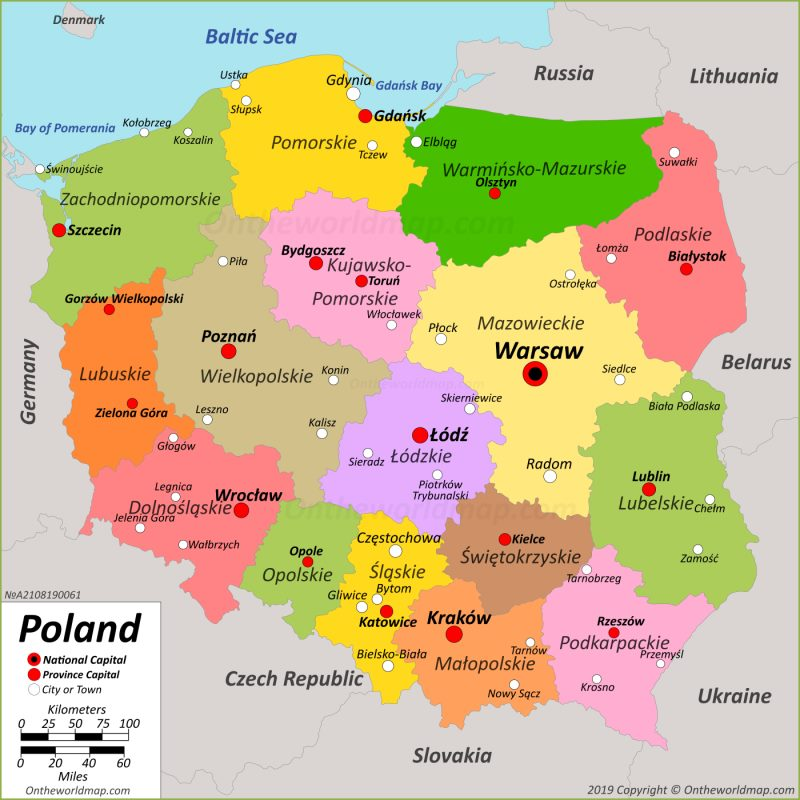
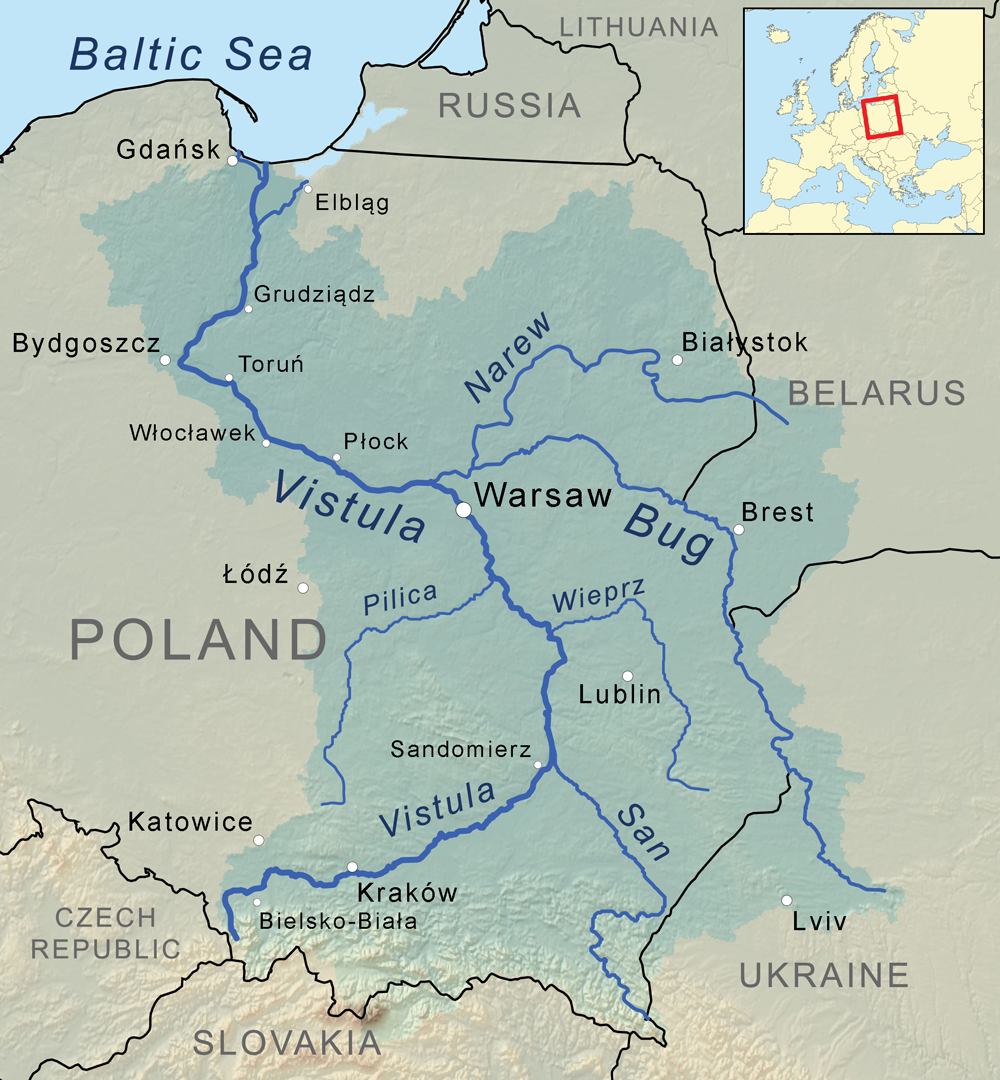
It makes perfect sense that Gdansk was a key port since its founding. As well as a large harbour, Gdansk is on the Motlawa River and is at the mouth of the Vistuala River system that provided a route throughout Poland for the transport of goods.
History
Gdansk was founded as a fortified port in the 960s and remained part of the Duchy/Kingdom of Poland until 1227.
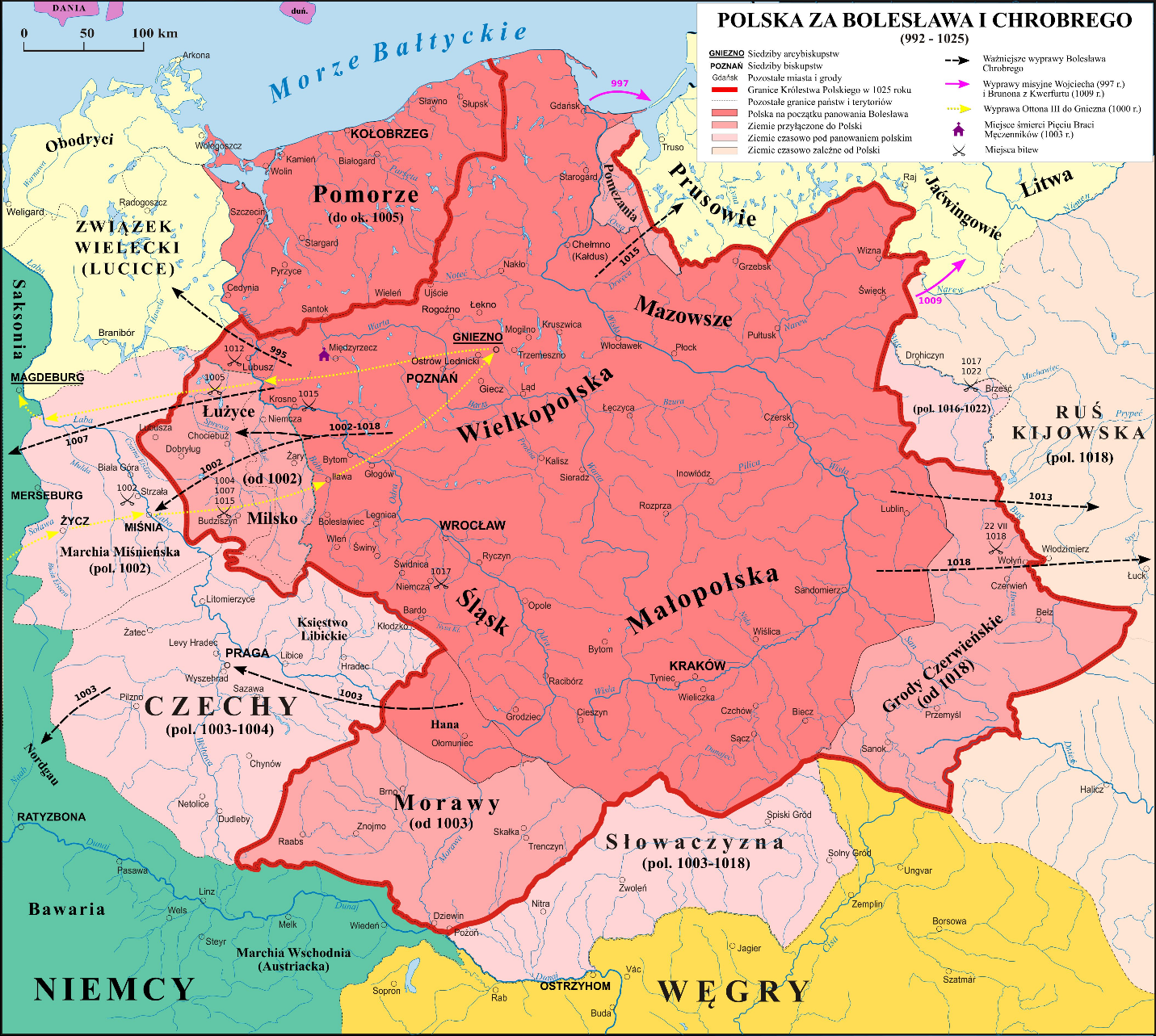
The Kingdom of Poland broke apart and Gdansk was under the rule of the dukes of Pomerelia, one of the regions of the former Poland from 1227 to 1282.
The Teutonic Knights, were a German Catholic Military Order who served in the Holy Land defending Crusader territories and protecting the Pilgrims. They shifted focus in the late 13th century, launching campaigns against pagans in Prussia, seizing Gdansk in 1308 and holding power until 1454. The Knights originally came to Gdansk to help expel invaders, but refused to leave, slaughtered the inhabitants and took over the region.
After the Thirteen Years’ War end in in 1454, Gdansk became part of Royal Prussia within the Polish Crown. This is the city’s longest period of prosperity, with wide autonomy, its own laws, and major Baltic trade. From1454–1569 Gdansk was part of the Kingdom of Poland, and from 1569–1793 part of the Polish Lithuanian Commonwealth. During this period Gdansk developed a unique architectural and cultural identity deeply rooted in its historical connections with the Low Countries. Beginning with the Hanseatic League (trading group) in the 14th century and intensifying during the 16th and 17th centuries, the city became a primary destination for Dutch and Flemish merchants, artisans, and religious refugees. This influx was driven by trade opportunities, the 80 Years’ War against the Spanish, and the migration of Mennonite communities. At the height of this period over 2,000 Dutch and Flemish ships yearly visited the harbour.
During this period Gdansk was acknowledged as one of the most beautiful and wealthiest cities in Europe.
The Long Market, home of the wealthiest residents, clearly shows its Flanders heritage.
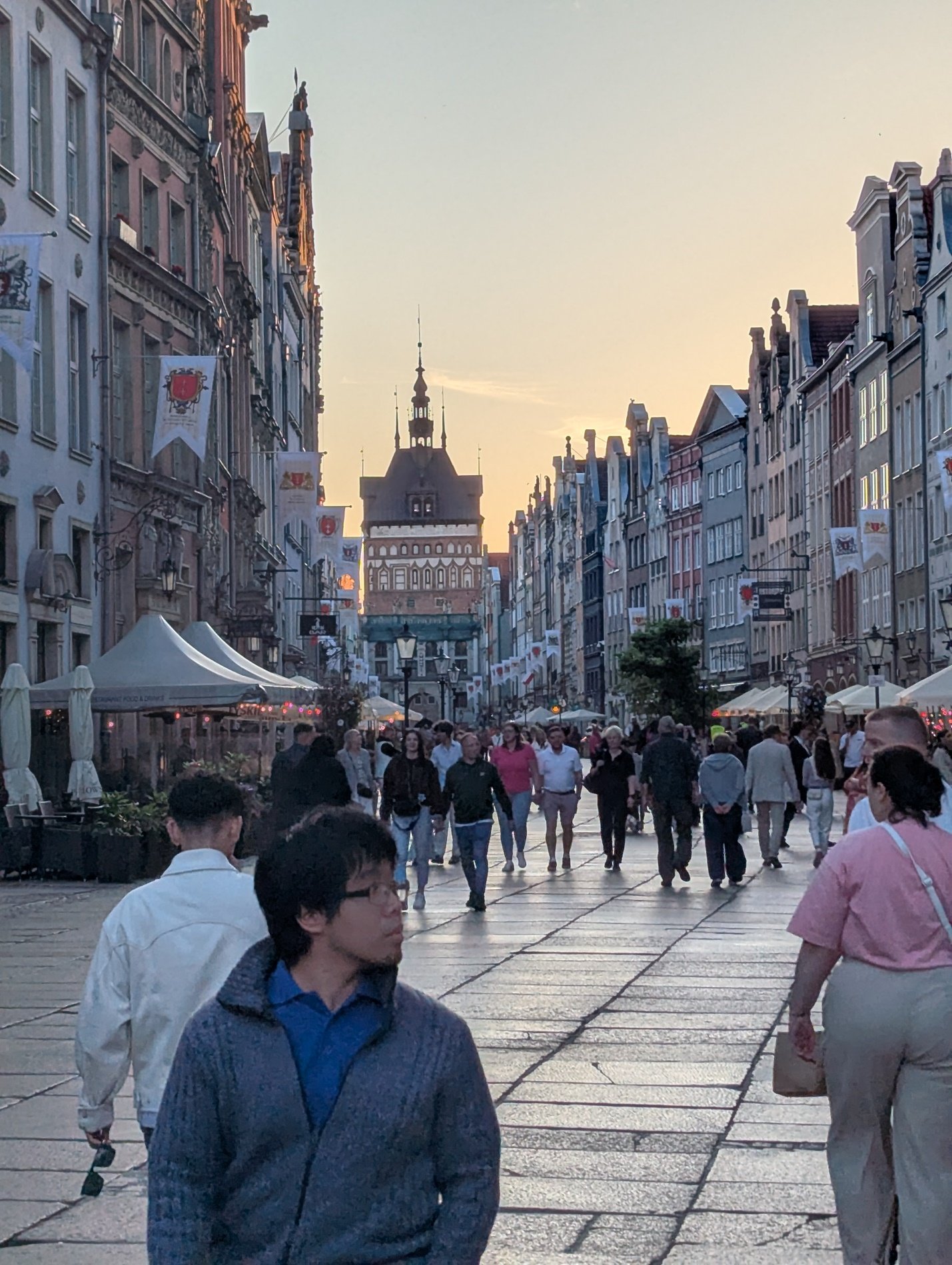
Prussia annexed Gdansk in the Second Partition of Poland (1793). With a short interruption, 1807-1814, as the free city of Danzig under Napolean, Gdansk remained part of Prussia until the end of the First World War.
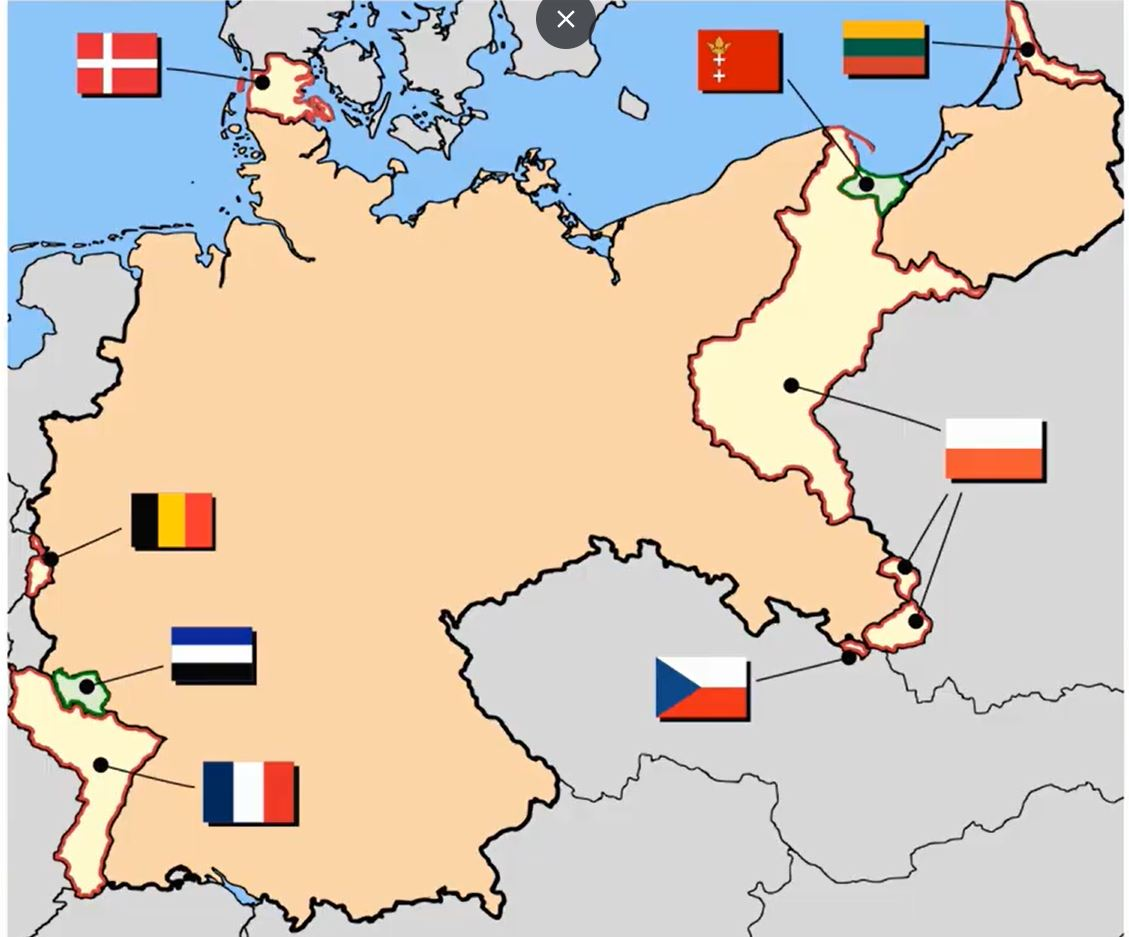
As part of the Treaty of Versailles in 1919, Gdansk was declared a Free City under the League of Nations. Poland controlled foreign policy, customs, port access, the Polish Post Office, and a military outpost at Westerplatte, guarding the harbour. This was a compromise agreement that provided Poland access to the Baltic Sea but did not put the 90% German population under Polish Rule. This gave rise to German Nationalism and by 1936 the Nazi Party was in control. The Nazi party began to identify enemies of the city state and Hitler pressed for annexation. Poland’s borders were much reduced as part of this settlement and having Germany on both sides was a recipe for disaster. Gdansk is the small green area top right.
Germany and Russia invaded Poland in September 1939 and occupied the country. Poles and Jews were persecuted, deported, or murdered and multiple concentration camps were established in Poland.
After the war, the Potsdam Conference returned Gdansk to Poland but Poland was placed under Soviet control and became a Communist Country. The German population was expelled; Poles imported and the city was rebuilt and again became a major shipbuilding center. In the 1980s, Gdansk became the birthplace of Solidarity, which helped end communist rule. Since 1989, it has been part of the Republic of Poland.
Invasion
Treaties
Not that it did them any good, but Poland had nonaggression treaties with both Germany (1934) and Russia (1932) after several Poland-Russia battles in the 1920s. As Germany continued to annex countries, on 19 May 1939 France and Poland signed an agreement that France would support Poland in the event of an invasion. France agreed to immediate Air strikes, a limited invasion by day 3 and a full-scale invasion of Germany by day 15. France did declare war on Germany on 03 September and launched a small offensive but decided to go on the defensive and leave Poland to fight on their own. The Poles were betrayed as they had built their defensive plans based on French intervention.
On 31 Mar 1939, Britain agreed to come to Poland’s defence if they were invaded and the countries signed a full pact of mutual assistance on 25 August 1939. A week later, Germany invaded Poland and Britian declared war two days later, much to the surprise of Hitler, who assumed the Brits would do nothing as they had in previous annexations.
The secret treaty between Germany and Russia, the Molotov–Ribbentrop Pact (23 August 1939) carved up Poland, the Baltic States, Finland, and Romania between Germany and the USSR. This was a great surprise to Britain who had counted on Russia as an ally to blunt German Aggression.
Nazi Rise to Power
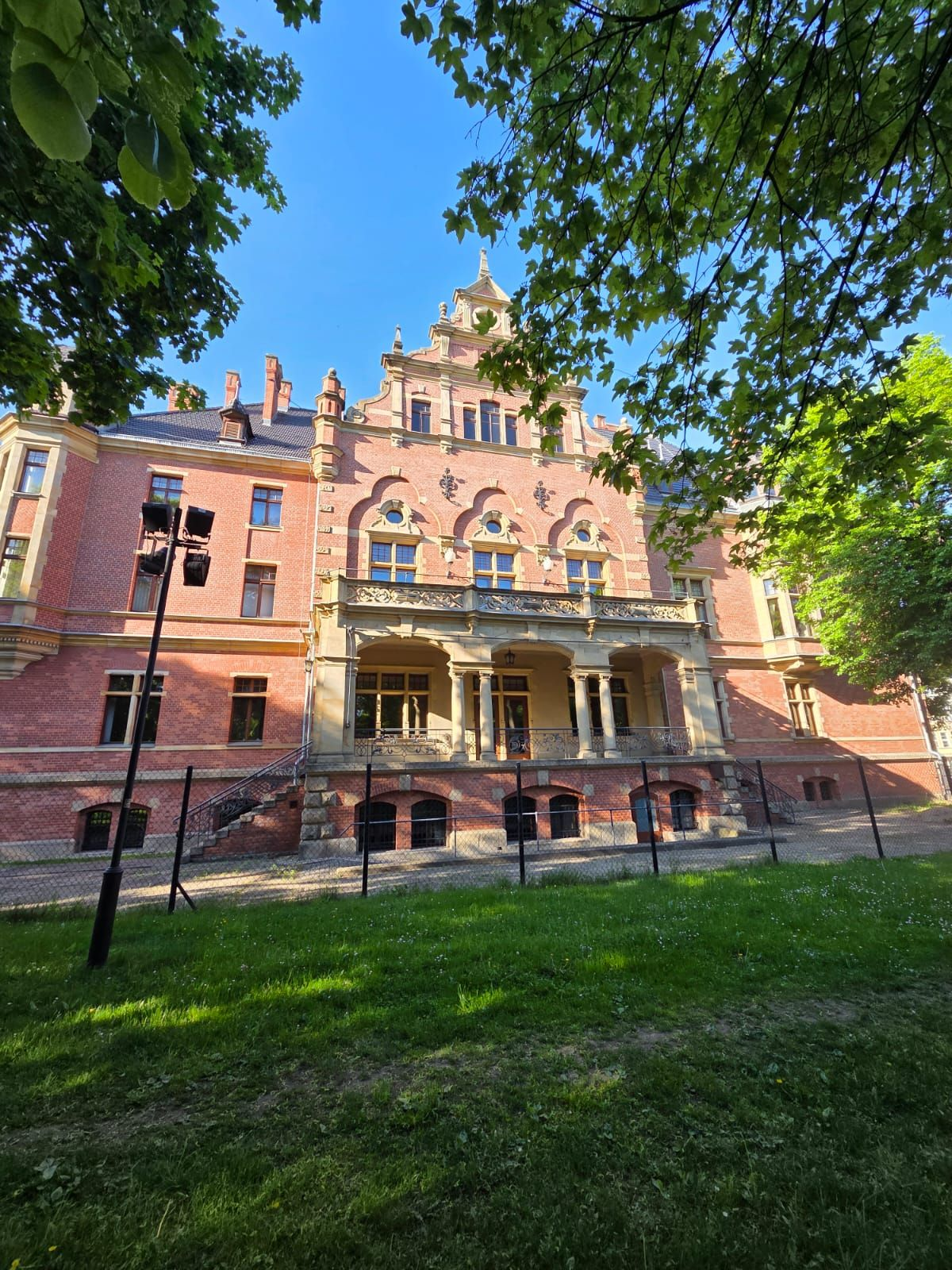
Since Gdansk had been under Prussian rule since 1793, it was about 90% German and as the Nazis rose to power the push for Annexation became stronger. By 1936 the Nazi party was in power in Gdansk and began to build their list of enemies, mostly activists and Jews to be rounded up as soon as war began. Over 20,000 prisoners were executed in the first two months after the invasion. The building that is now the New Town Hall was built as a Prussian Garrison in 1901, taken over by the league of Nations in 1919, then served as German Headquarters after the fall of Gdansk. After the war it was taken over by the Communists, becoming a cultural centre in 1991 after the fall of communism before finally becoming the New City Hall in 1999.
German Invasion
Westerplatte – 01 September 1939
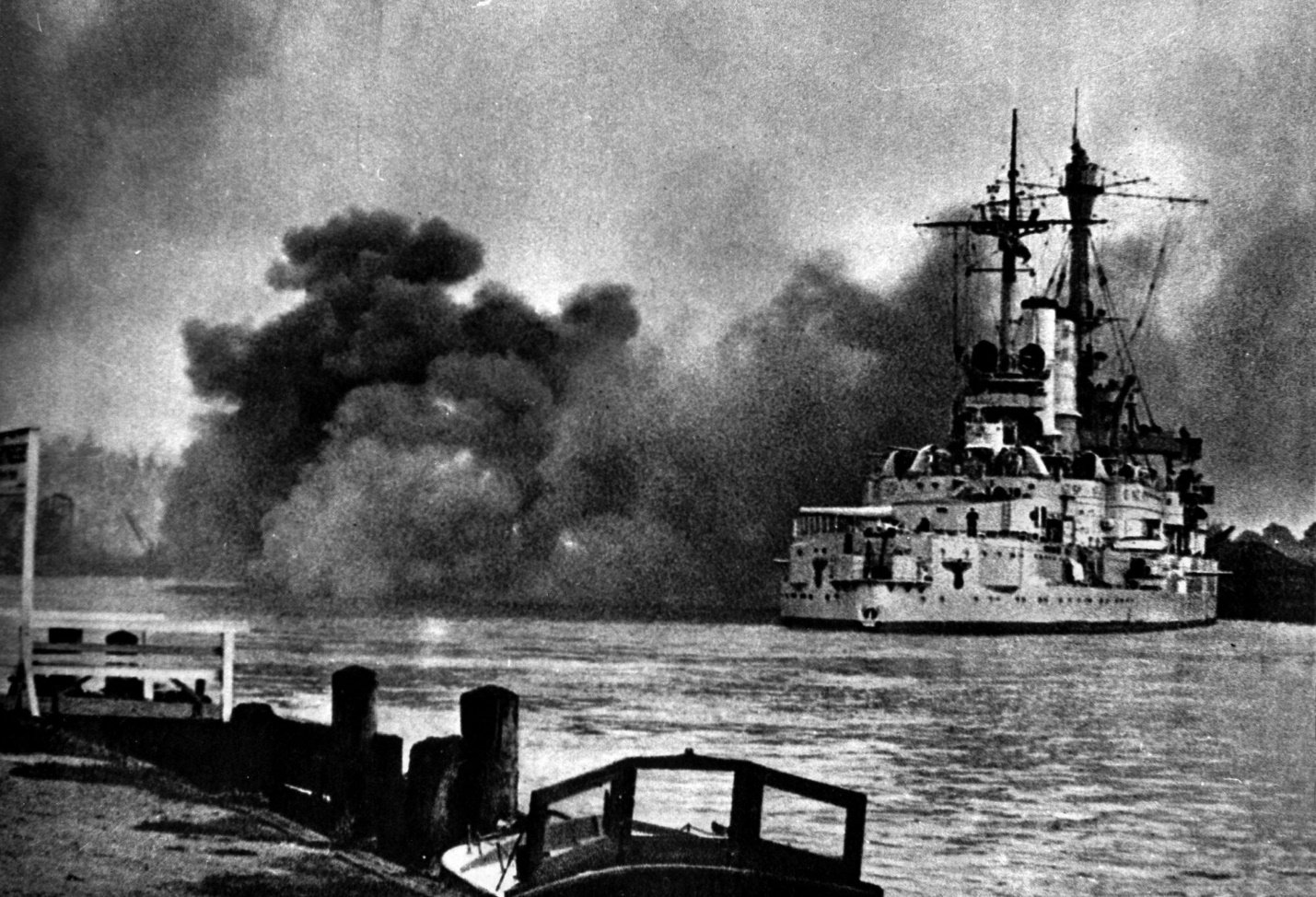
Germany started massing troops at the border and creating several false flag operations to provide an excuse for their invasion. The German ship Schleswig-Holstein made a courtesy visit to Gdansk and at 0447 on 01 September opened fire on the Polish defences at Westerplatte and the 250 marines hidden on board attacked. They expected a walk over but instead met heavy resistance.
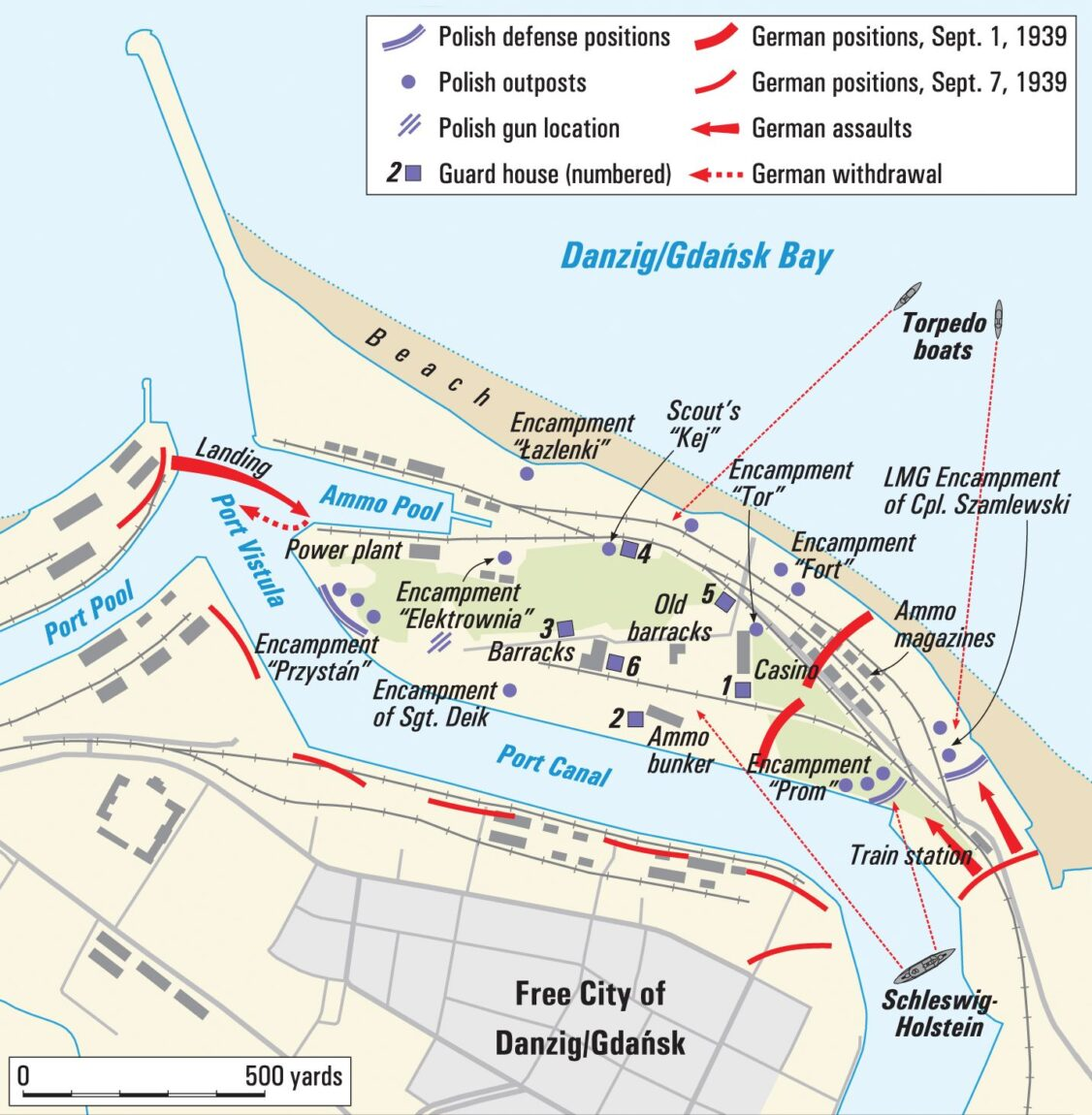
The ship firing on the Westerplatte defences.
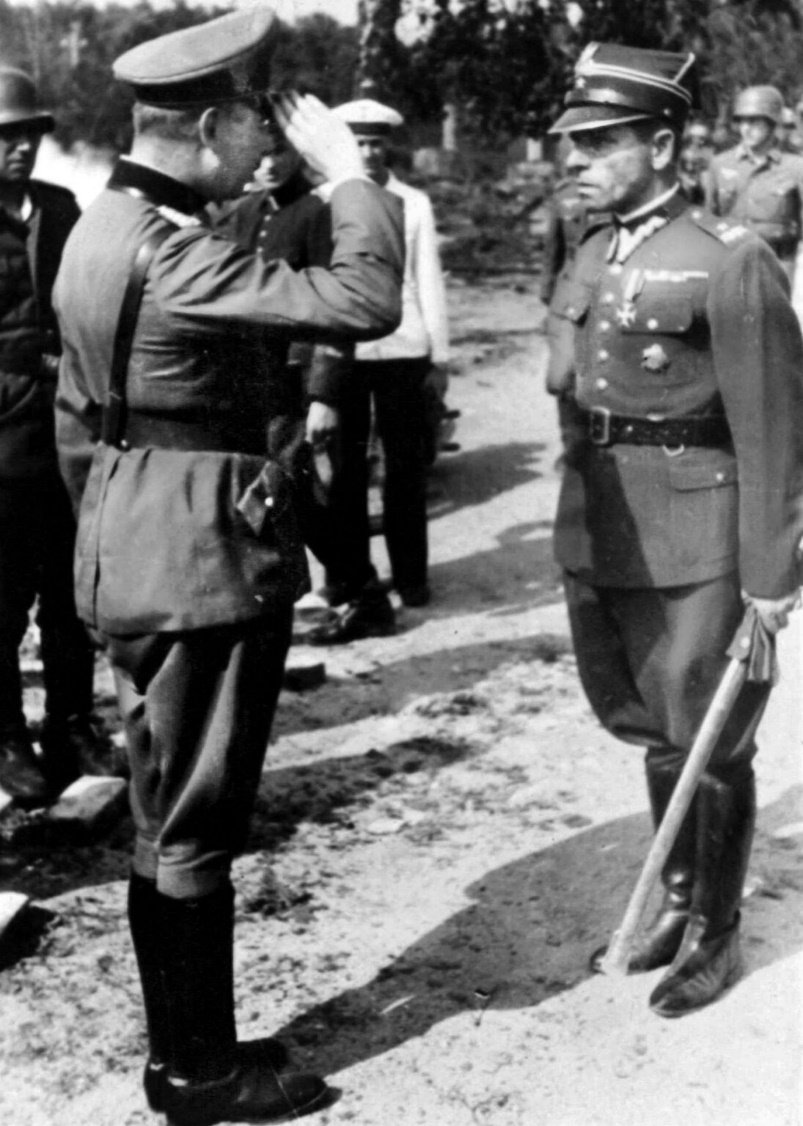
The 300 defenders fought valiantly against 3,000 invaders surviving air strikes and constant shelling before running out of food and ammunition on 07 September. The Germans were so impressed with the Poles that they saluted the Prisoners of War as they marched past the German troops and allowed the commander to retain his sword.
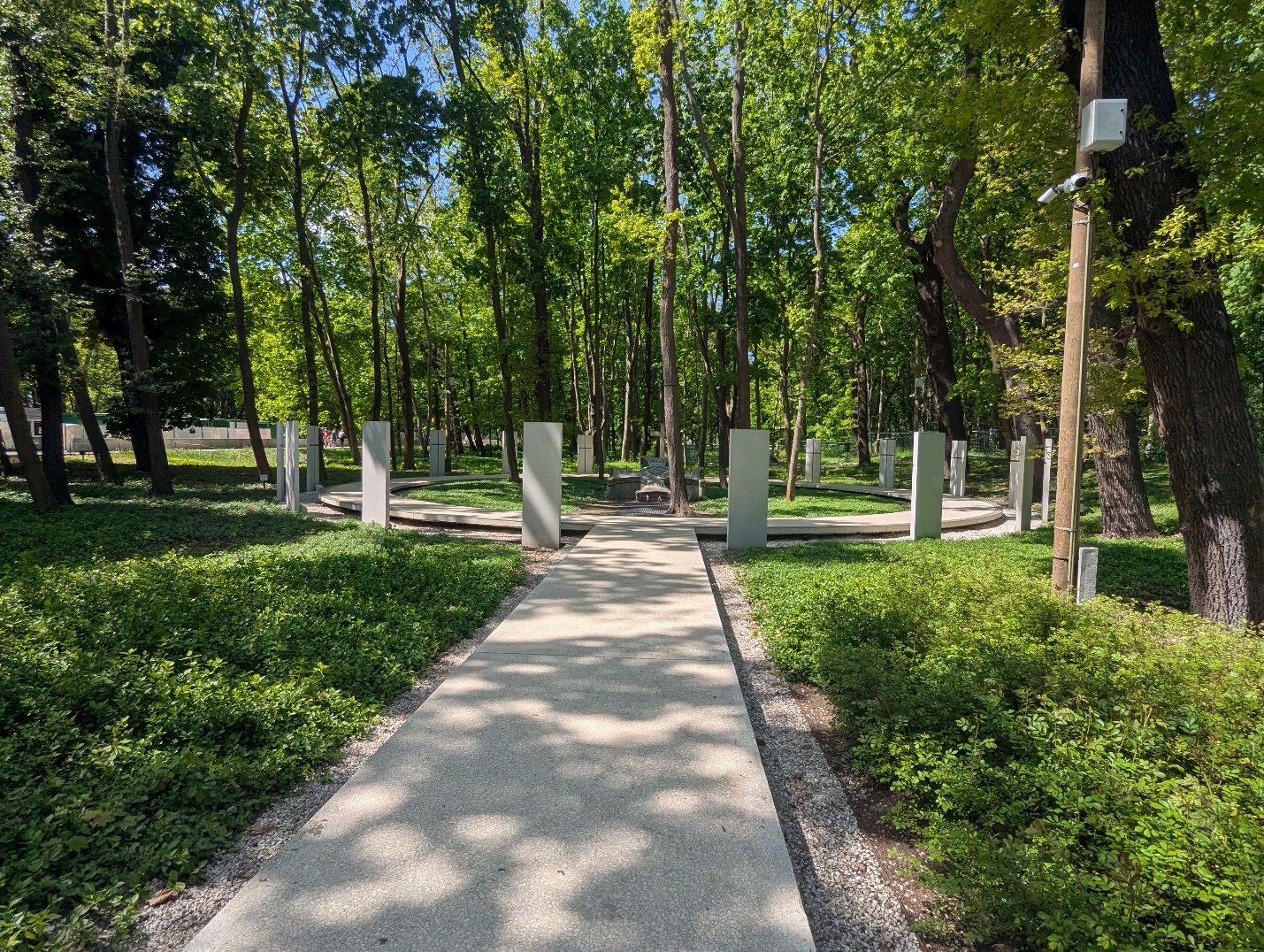
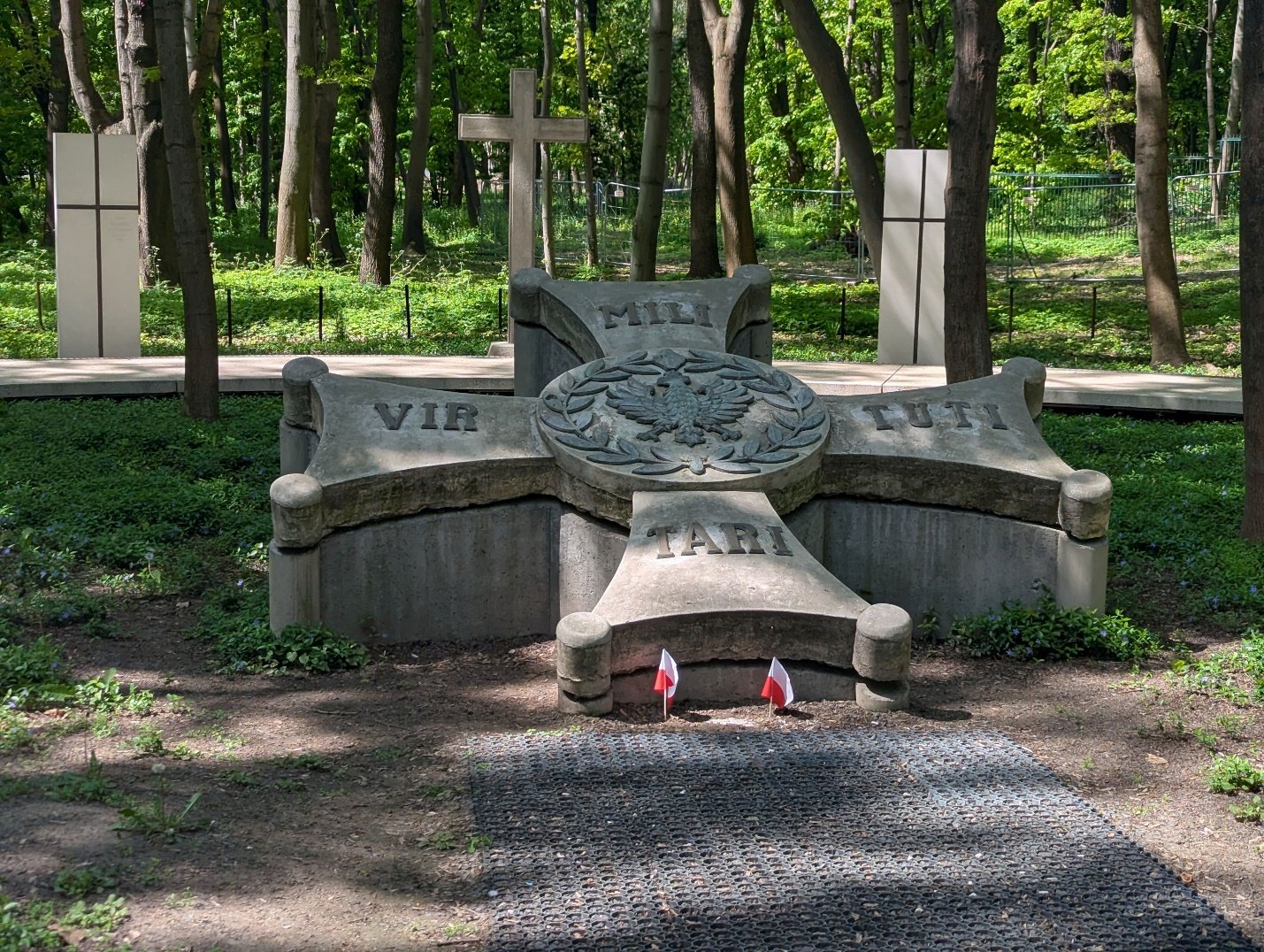
The entire Westerplatte area is now a memorial to the defenders. The list of names of the fallen are placed on columns with the Polish cross in the centre.
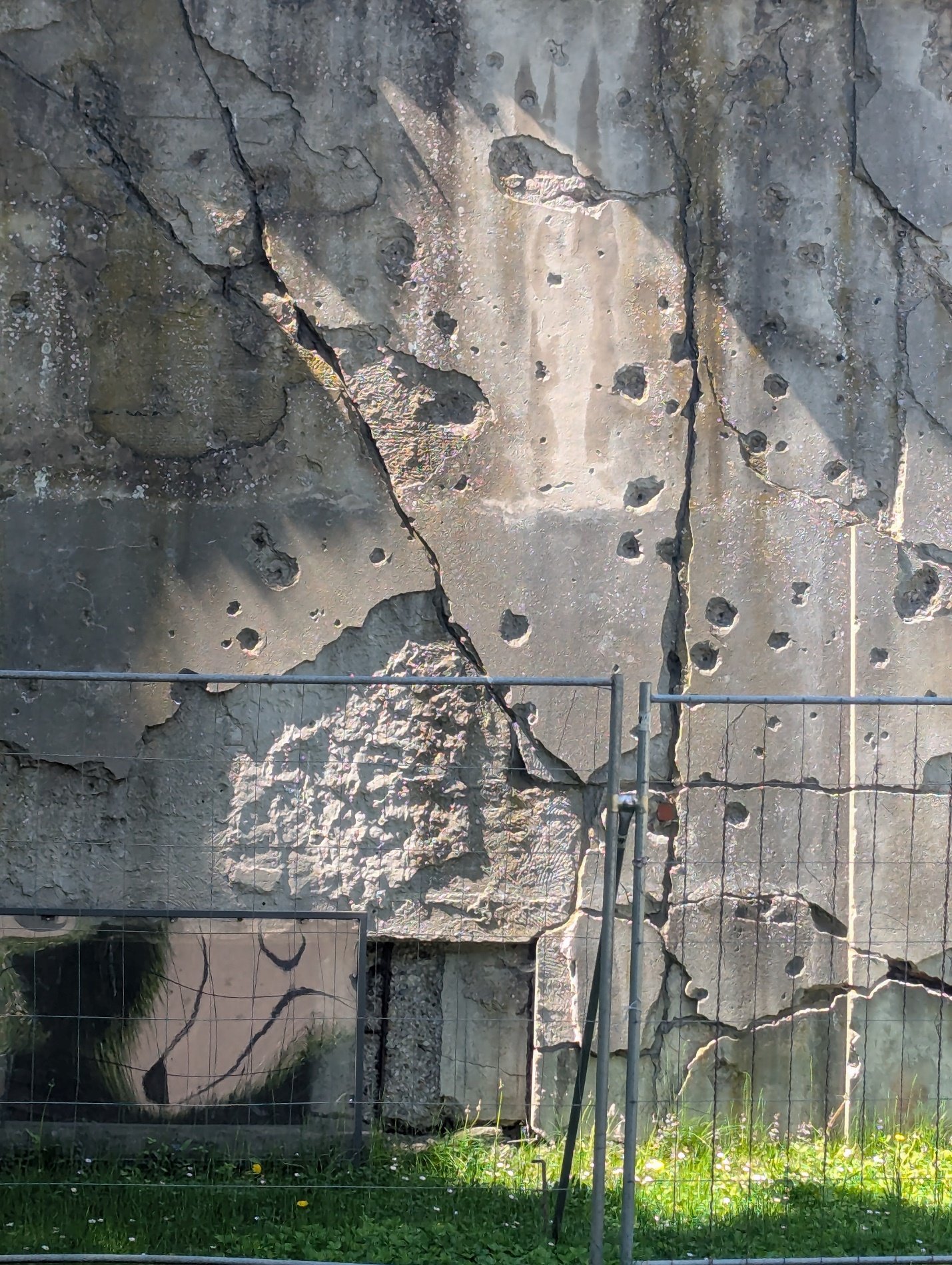
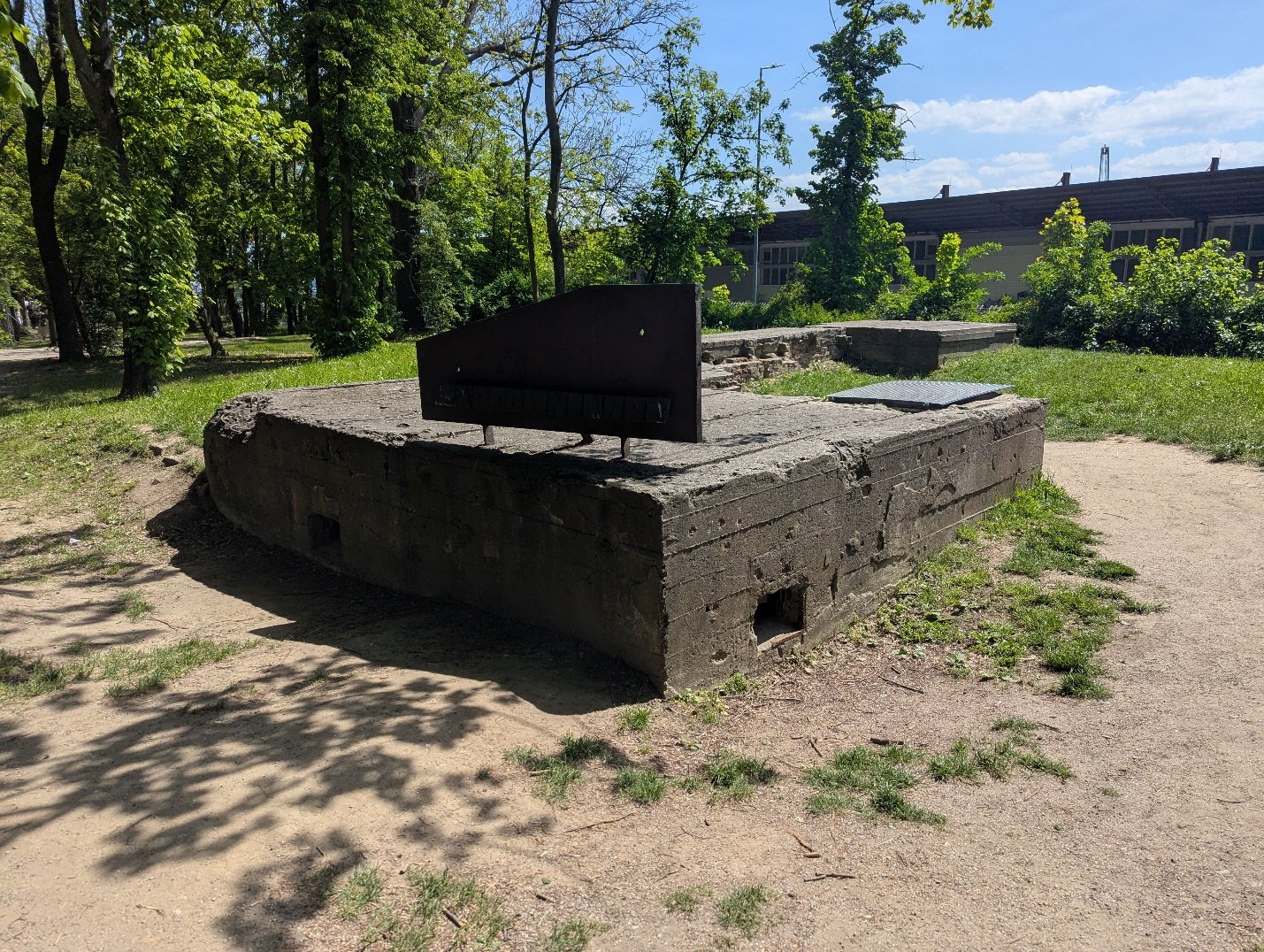
There are a number of bunkers left as well as the well-damaged frame of a barracks building.
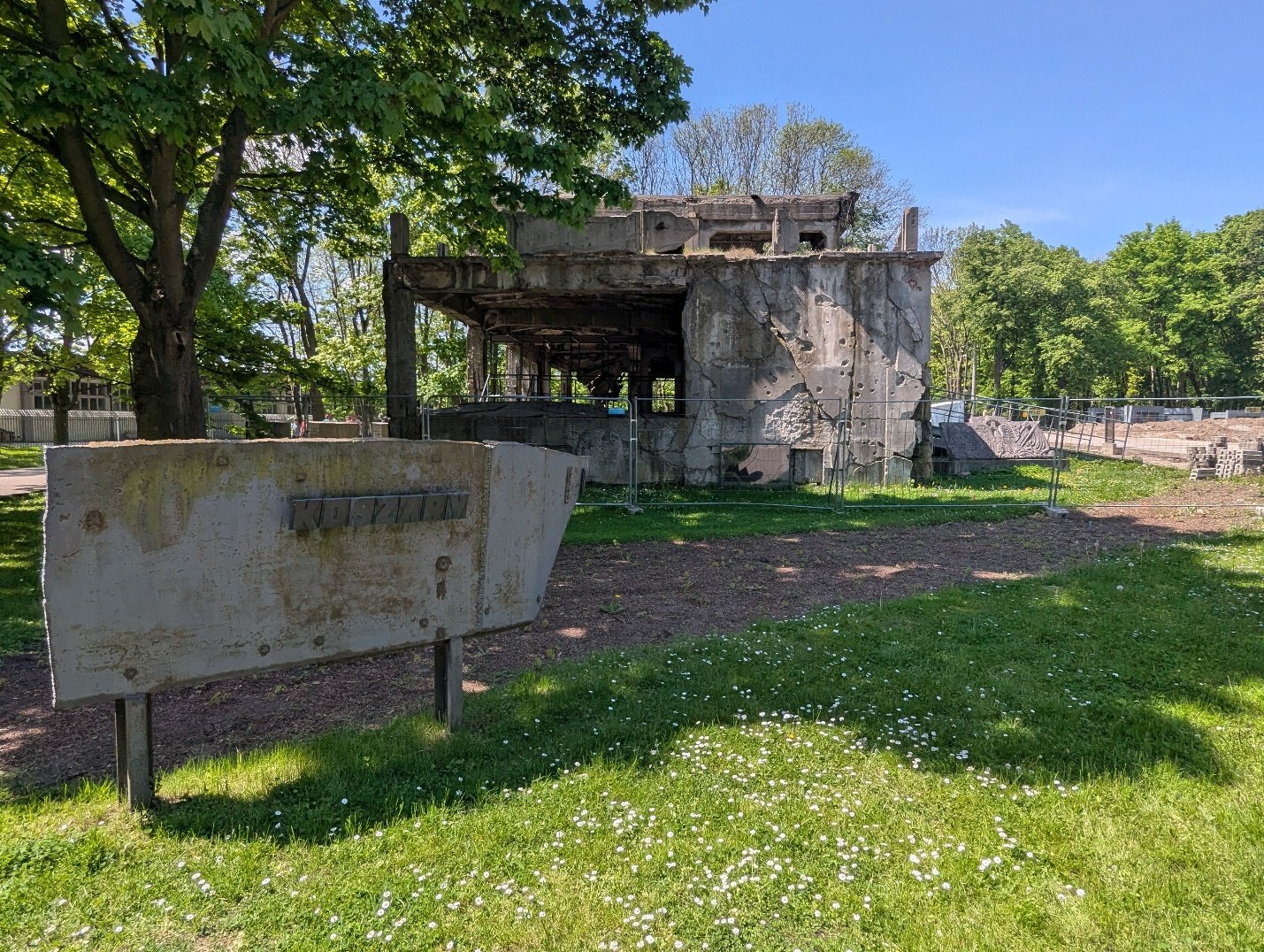
Damage to the barrack block.
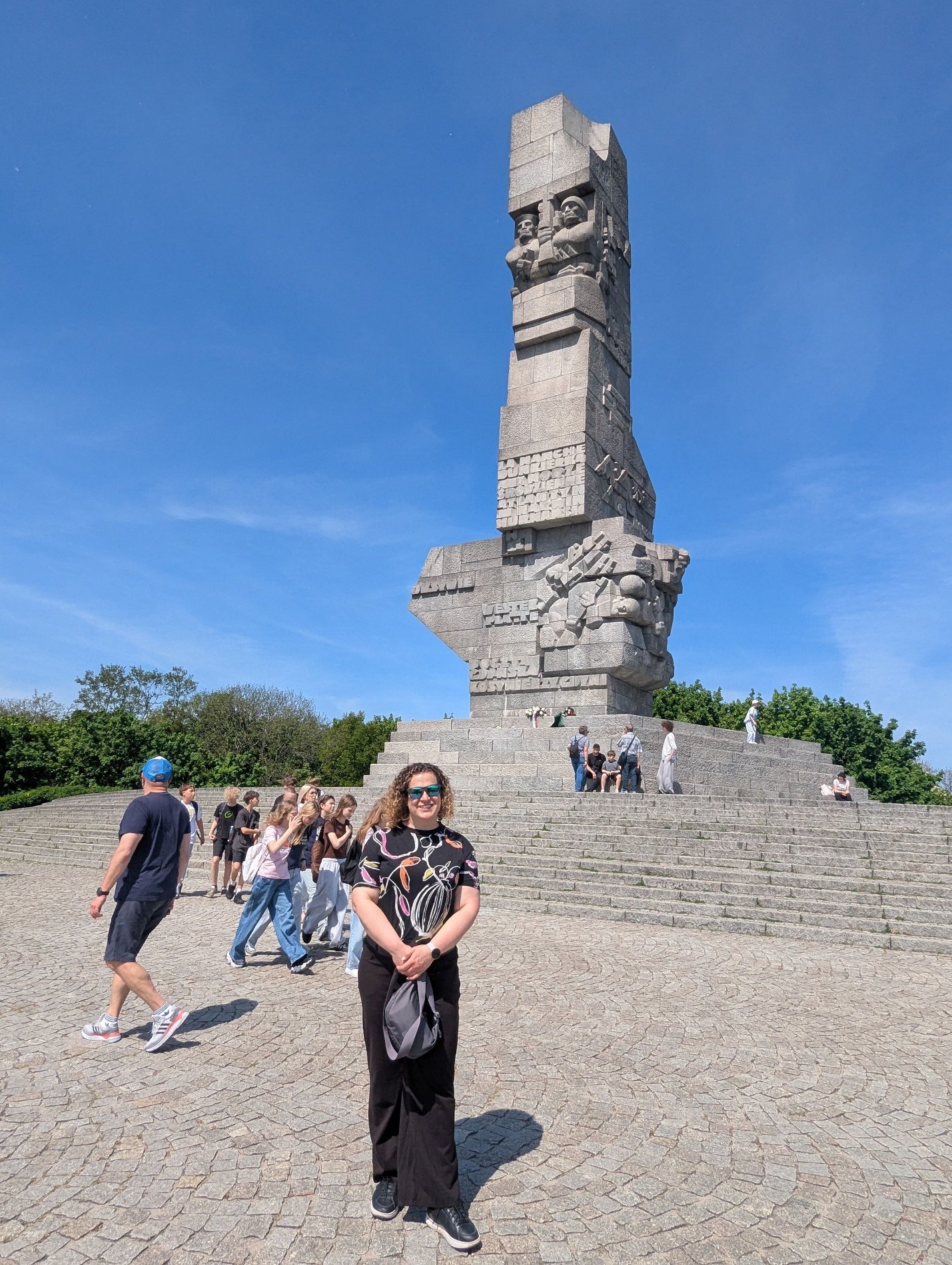
The Westerplatte Monument, also known as the Monument to the Defenders of the Coast on the Westerplatte Peninsula in the Gdansk harbour channel was constructed between 1964–1966 to commemorate the Polish defenders of the Military Transit in the Battle of Westerplatte, the first battle in Germany’s invasion of Poland, which marked the outbreak of World War II in Europe.
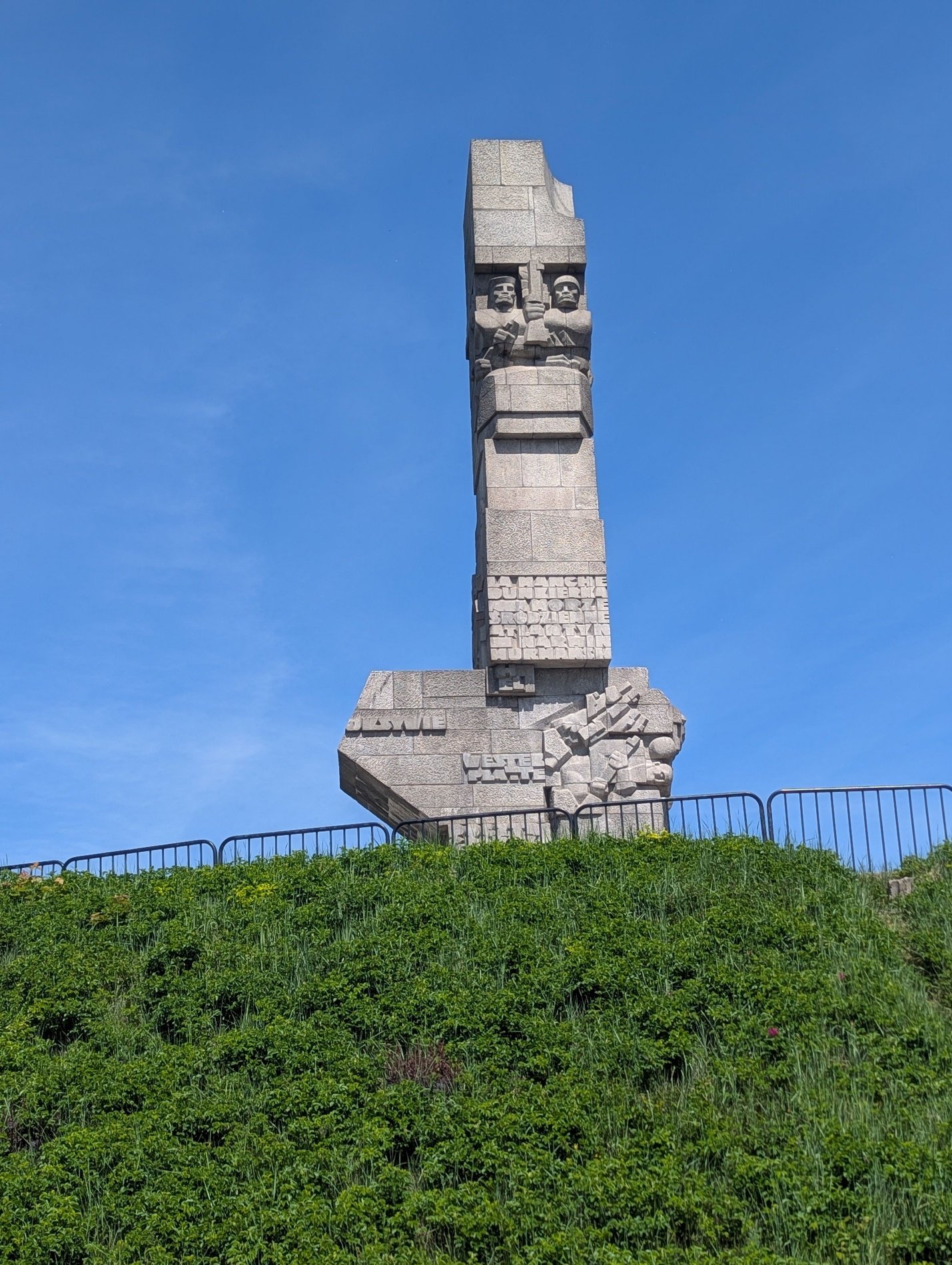
The monument is installed on a hill overlooking the harbour, with a winding path to the top. Rachel paying her respects.
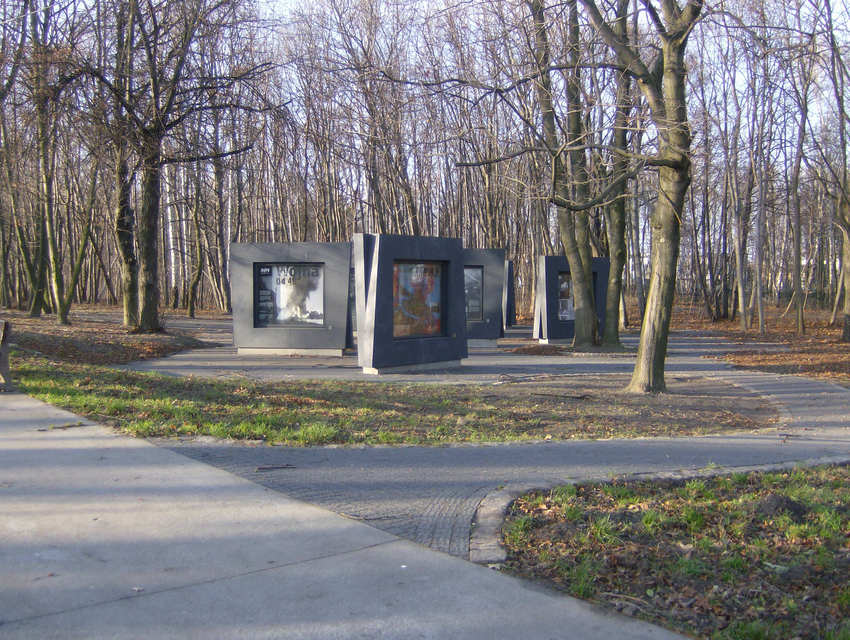
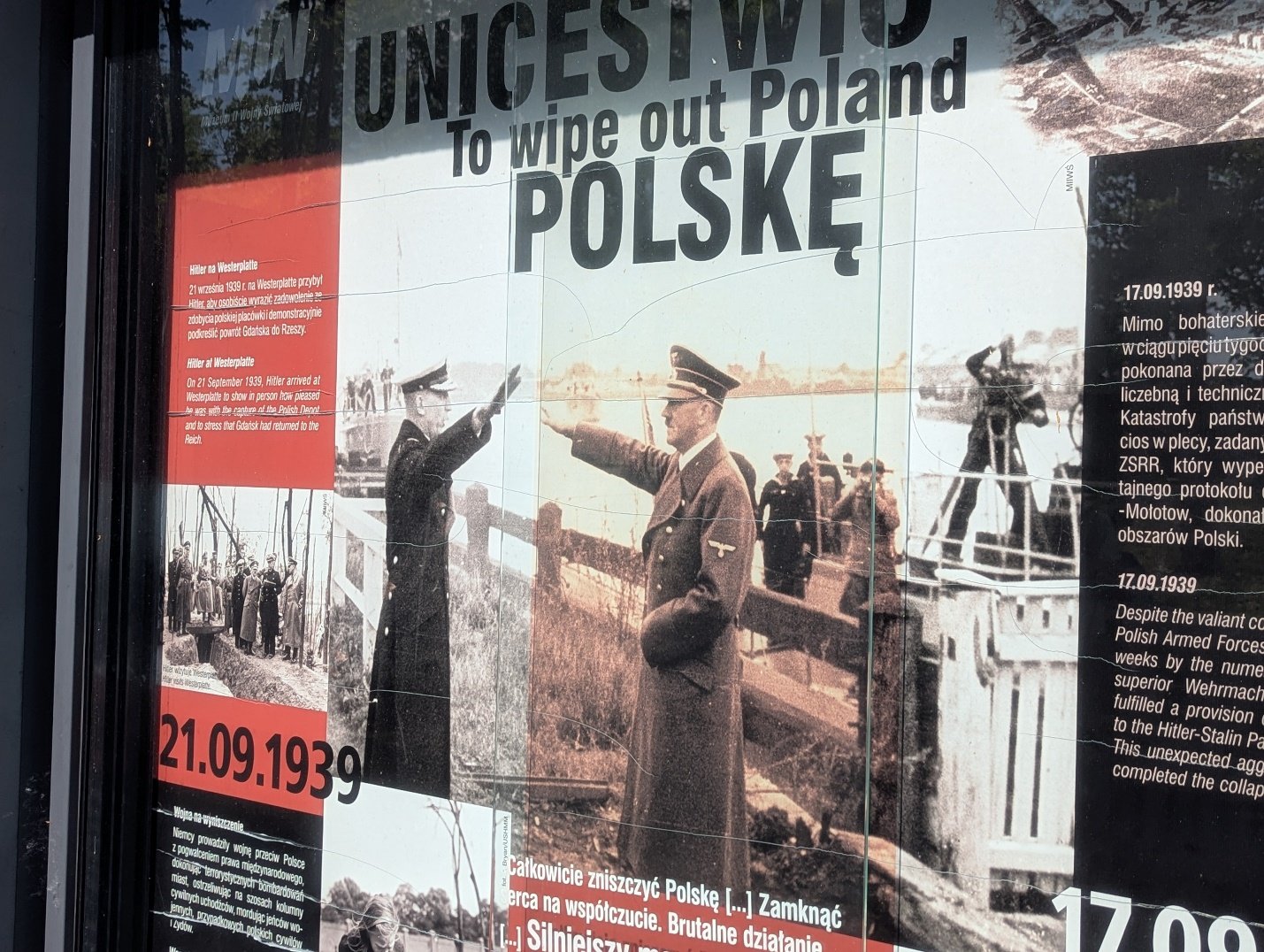
There are 28 permanent and a few seasonal information panels on the path showing details of the Battle of Gdansk in English and Polish. The panels were created by personnel from the museum on the grounds and provide a detailed and accurate interpretation of events.
Panel showing the meeting of Hitler with the Soviets as they divide Poland.
The entire Westerplatte site has nature trails combining remembrance with modern recreation.
Gdansk Post Office
The Post Office was one of the few Polish controlled entities in Gdansk so they were militarily trained and armed with machine guns. At 0430 on 01 September, Danzig police, Schutzstaffel (SS) troops – Hitler’s police force and Sturm Abeilung (SA)- Brownshirts units attack the Polish Post Office with armoured cars, artillery, and over 180 men. The defenders included 56 people — postal workers, volunteers, and one combat engineer, who had fortified the building. They had 3 light machine guns, pistols, grenades, and an anti‑tank rifle.
In the morning, Germans assaulted repeatedly from two directions. In the late afternoon the Germans brought in 75mm artillery and 105mm howitzers, blasting the building. Finally, they pumped gasoline into the basement and ignite it. The defenders, burned and suffocating, surrendered and the 38 survivors were captured.
A German court martial declared them illegal combatants and sentenced them to death on 5 October 1939. All were executed. The verdict is now officially recognized as judicial murder.
The rebuilt Post Office.
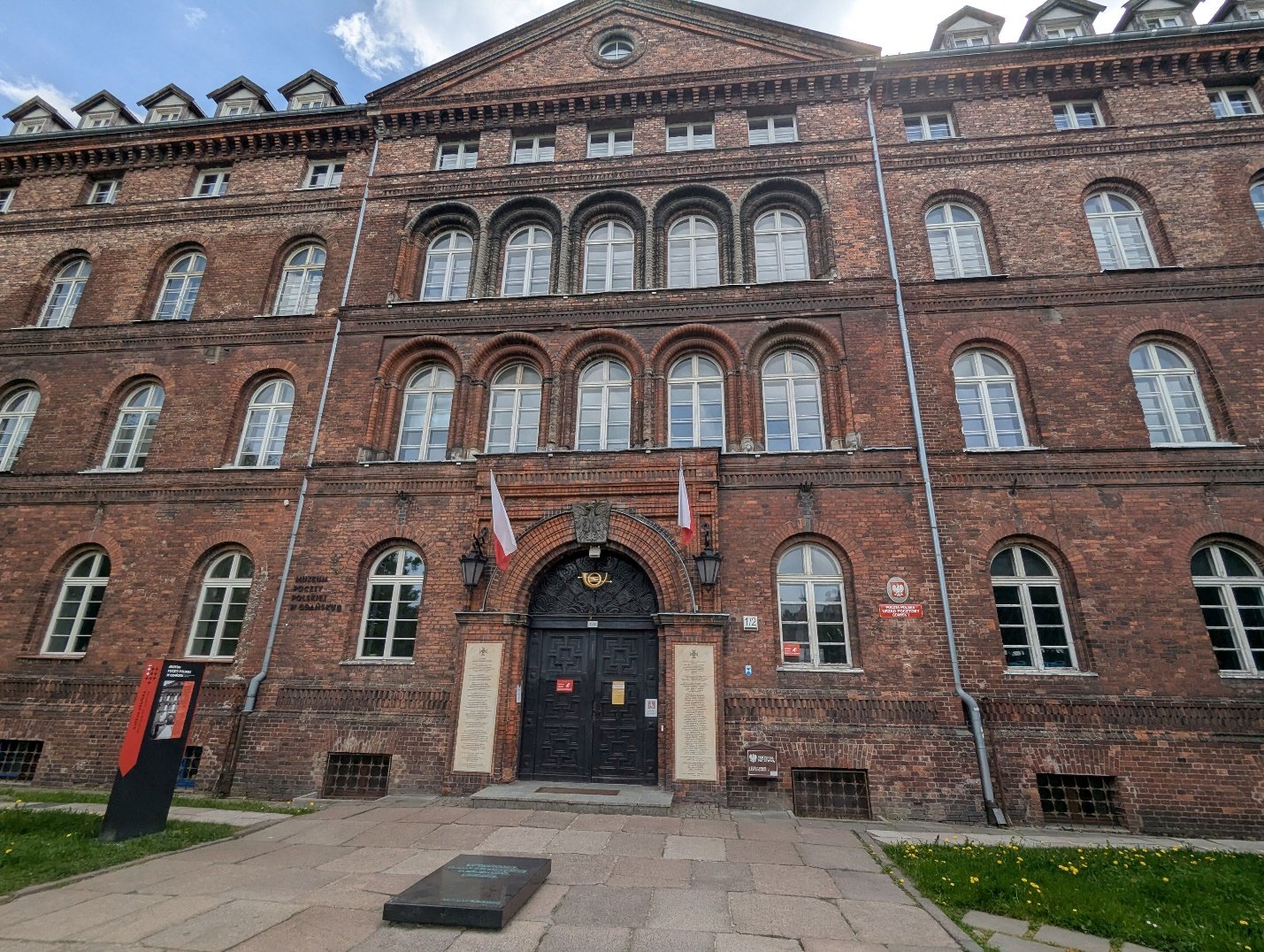
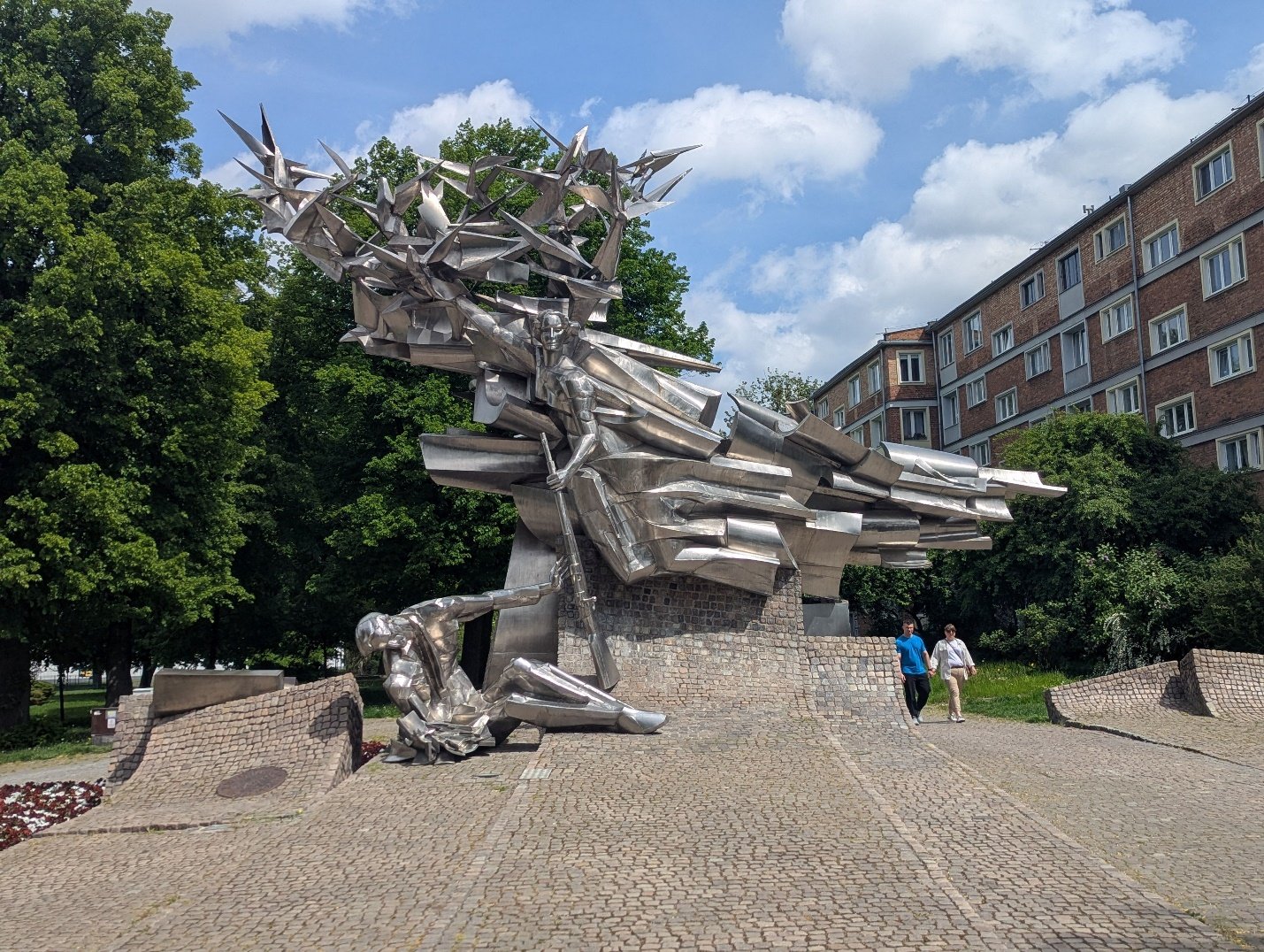
The courtyard behind it contains the Monument to the Defenders, one of Gdansk’s most important WWII memorials. The figures are exhausted, wounded, and human, capturing the last moments of the 15‑hour defence by civilians.
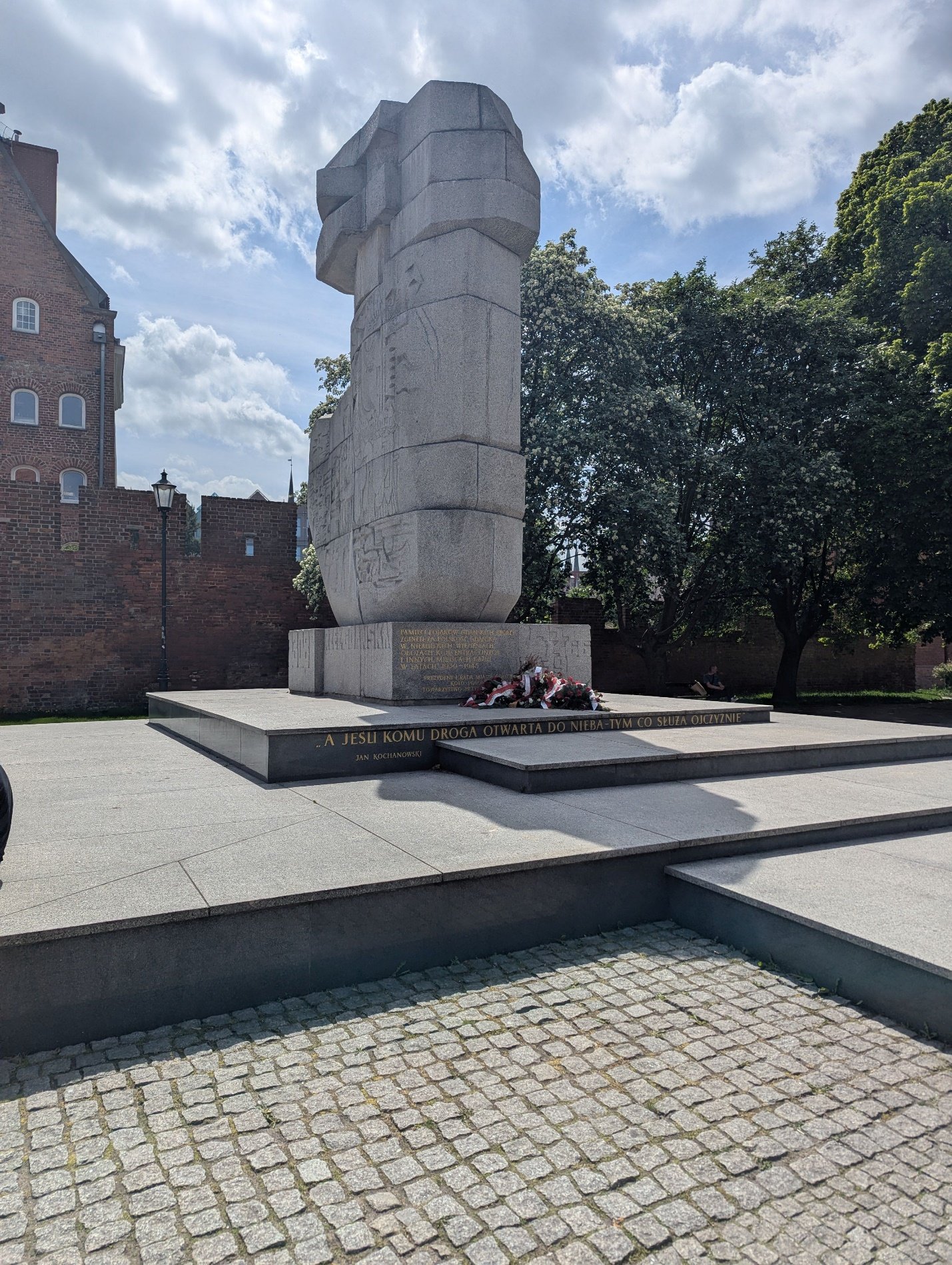
Nearby is the Monument to the Defenders of the Polish Character in Gdansk, commemorating those who fought to preserve Polish identity in the city. The granite monument honors victims and defenders from the 1308 Teutonic massacre through World War II. The monument is similar in design, but much smaller, to the monument at Westerplatte.
Soviet Invasion
The Soviet invasion of Poland began on 17 September 1939, when the Red Army crossed the eastern Polish border without a declaration of war. The campaign lasted until 6 October 1939, ending with the partition of Poland between Nazi Germany and the USSR.
Following the playbook that would be reused during the invasion of Ukraine in 2022, the Soviets stated the Polish Government had collapsed and the native Soviets required protection and deserved to be restored to their birthright.
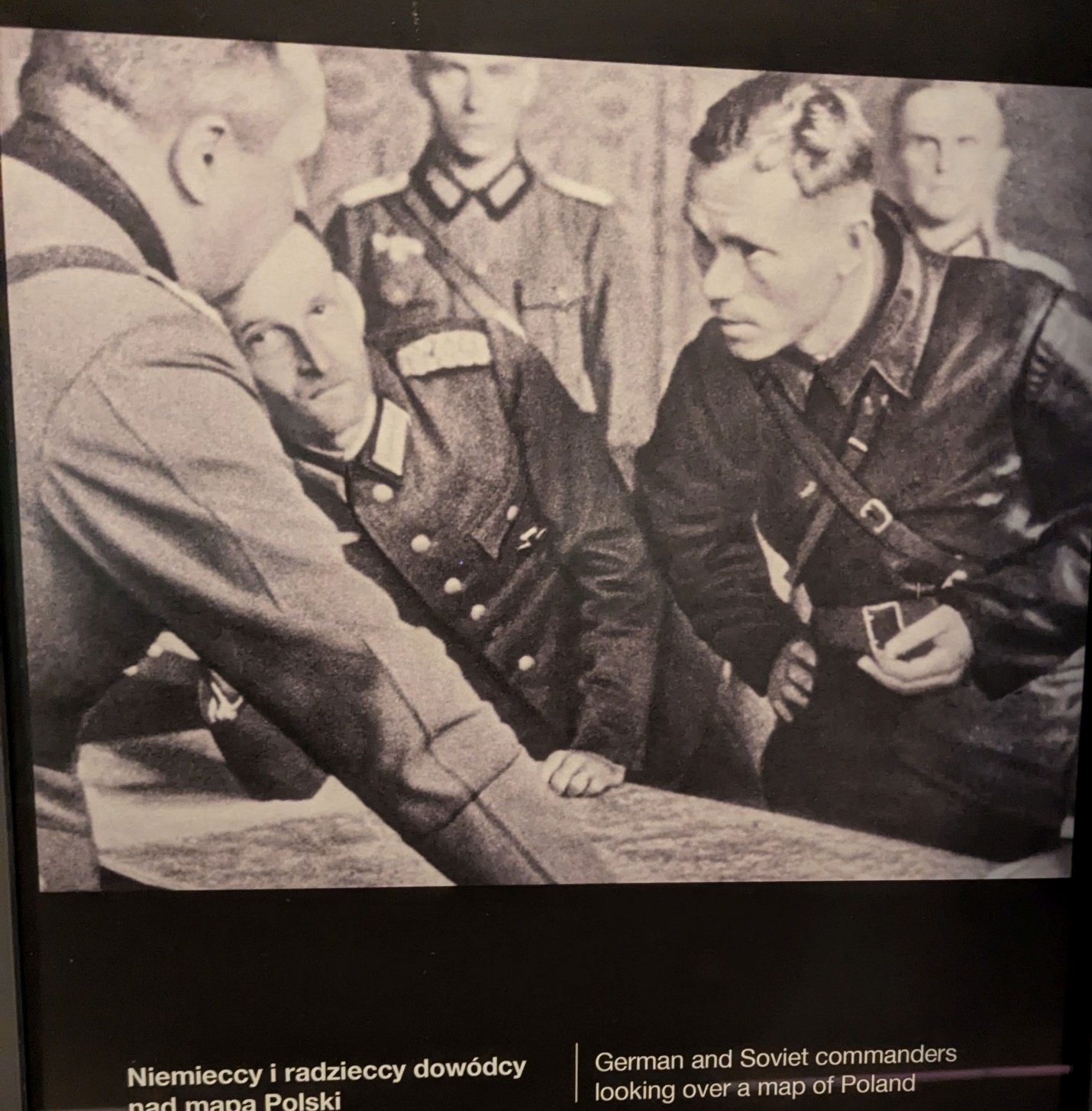
Germans and Soviets meeting to carve up Poland and the rest of Europe.
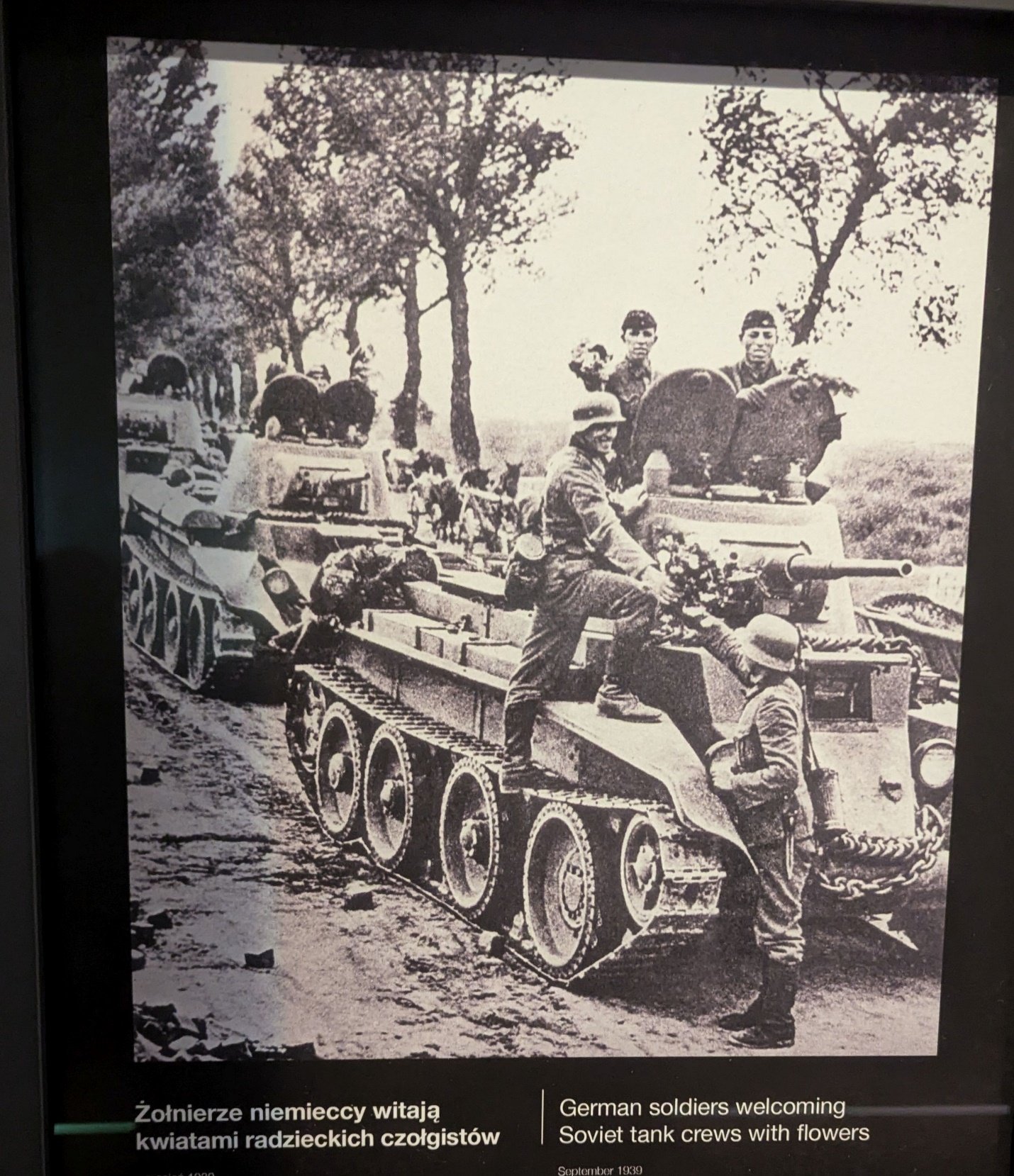
German soldiers giving flowers to Soviet tank crews when they met in Poland. This friendliness lasted until June 1941 when the Germans invaded the Soviet Union.
Occupation
Germans
Nazi rule in Gdansk was characterized by systematic repression of Poles and Jews. Since the Nazis had been in power since 1936, they had their lists well established once Gdansk Fell. There were Mass expulsions (1939–1943) with between 120,000 and 170,000 Poles and Jews were deported from Gdansk and nearly 120,000 German settlers were brought in to replace expelled Polish residents. Between 30,000 and 40,000 members of the Polish intelligentsia were murdered in Greater Gdansk region as part of a targeted extermination campaign. Most of the Jews had previously been expelled so the remaining 6,000 were executed.
Soviets
After annexation, the Soviet regime began mass repression capturing 320,000–450,000 Polish soldiers, deporting hundreds of thousands of civilians to Siberia and Kazakhstan in four waves (1939–1941). Secret Police arrests, executions, and political terror, targeting officers, police, clergy, and officials were conducted on a regular basis. The also ran sham elections staged to legitimize annexation.
The Destruction and Rebirth of Gdansk
Destruction
Gdansk was heavily bombed by both the Allies and Soviets from1943. In March of 1945 when the Soviets took the town, they completed the destruction first by shelling then by burning and looting most of the buildings.
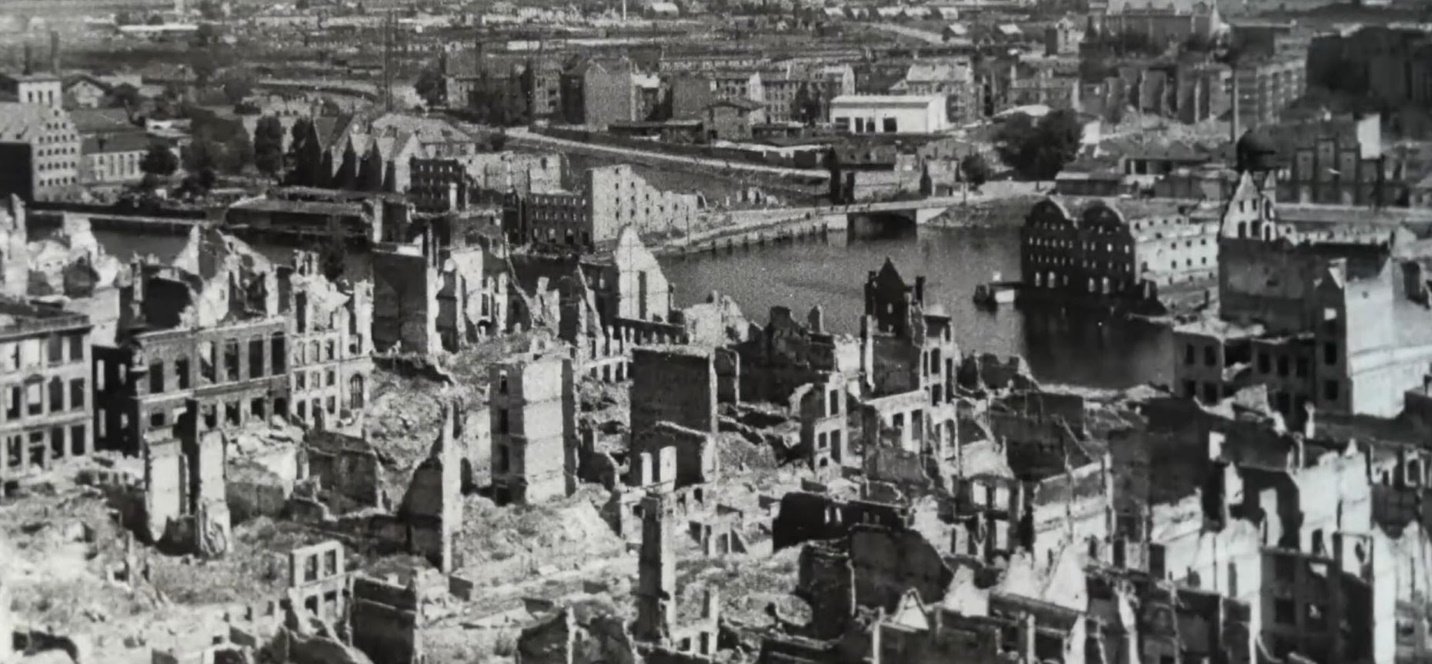
Over 90 percent of the building in Gdansk were destroyed.
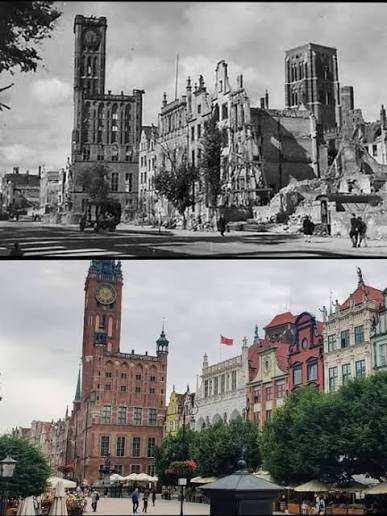
Old Town Hall
The first known city hall of the Old Town was erected on the Old Town Hall’s current site in 1382. It was expanded in the 15th century. In 1587, due to the risk of the original 14th-century structure collapsing, the current building was erected, designed by a Flemish architect.
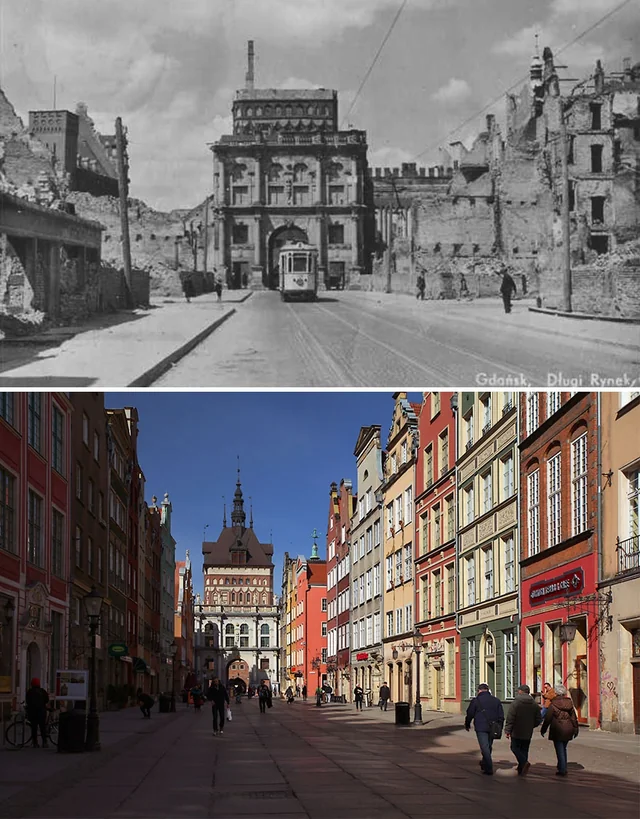
Old city hall and the Long Market before and after.
Artus Court
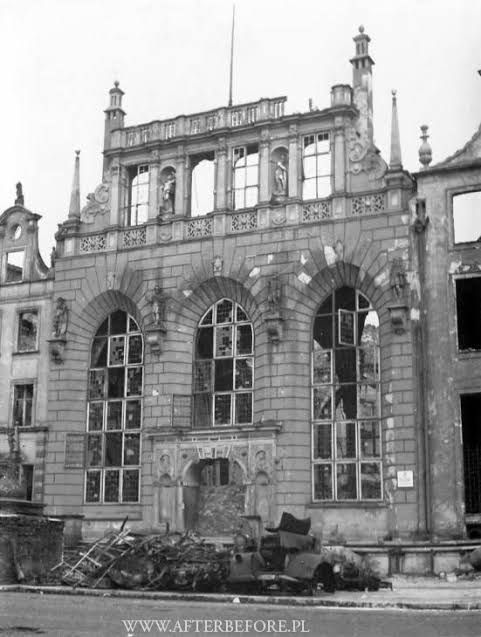
Artus Court was a meeting and entertainment building for the wealthy merchants. It was built near the old town Hall in 1494. It housed many art treasures that were fortunately mostly removed before the bombing of the city. The Façade remained but the interior was completely destroyed in the war.
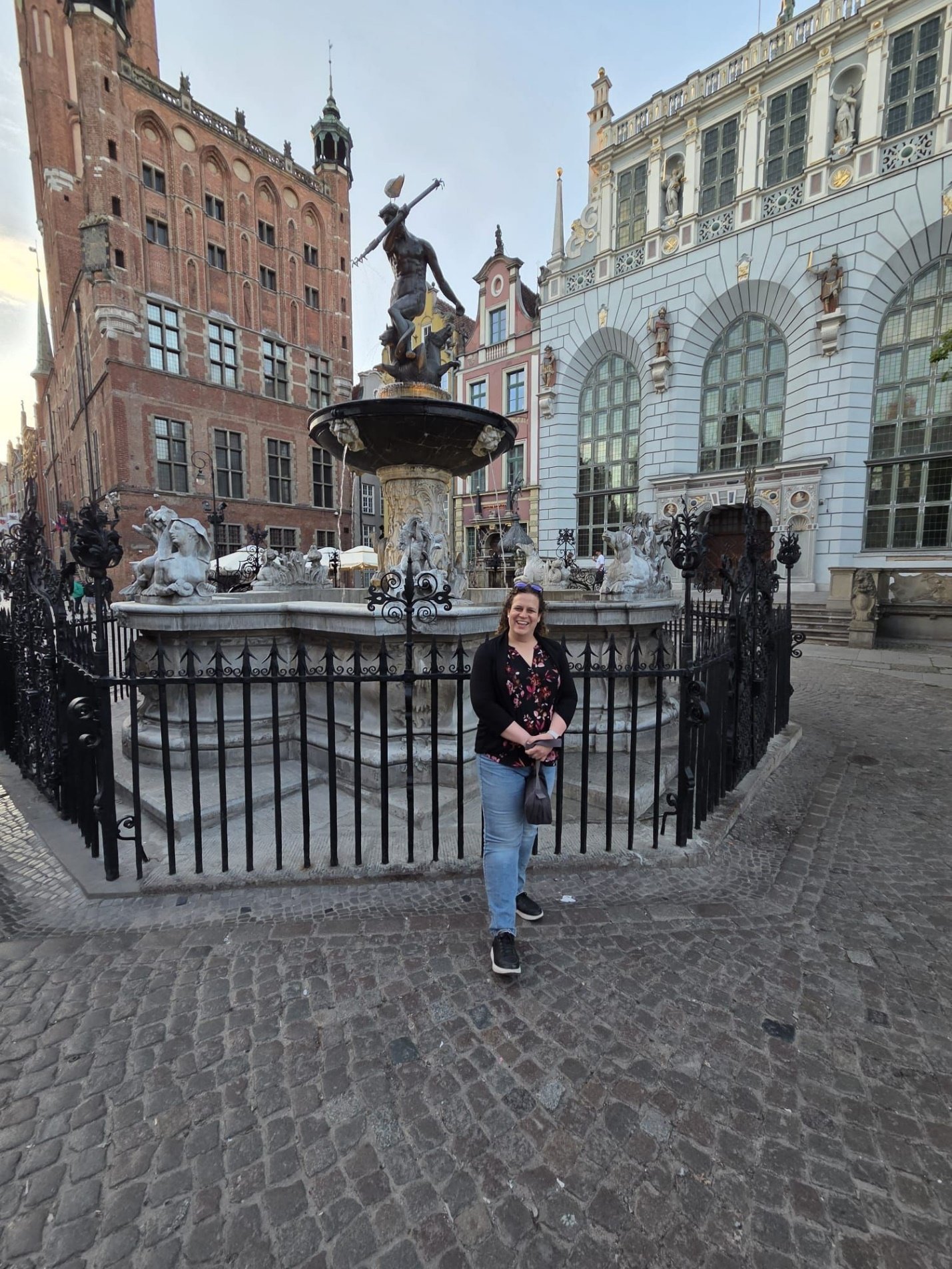
The modern Artus Court with the Fountain of Neptune and Rachel in the foreground.
The Golden Gate before and after.
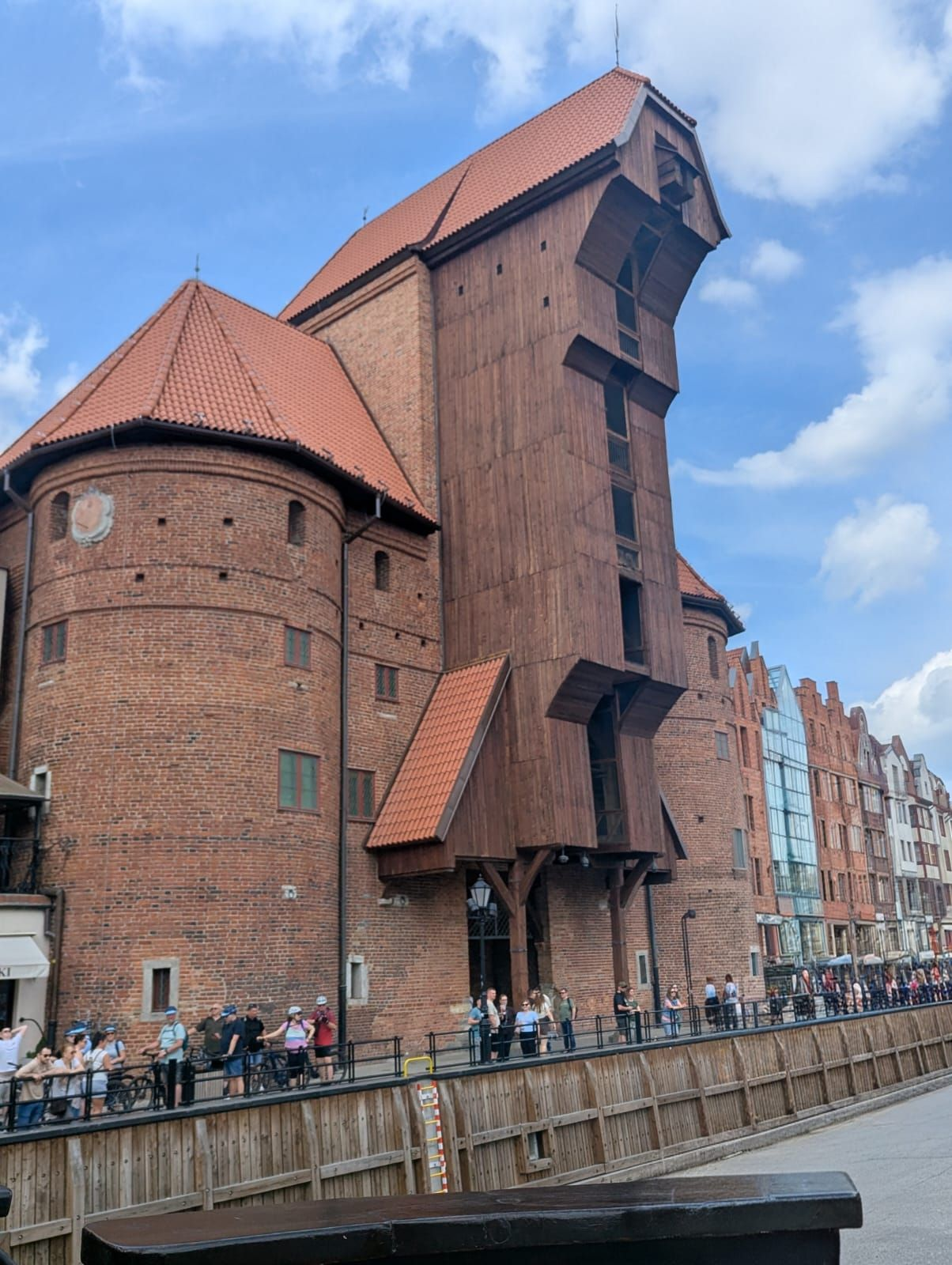
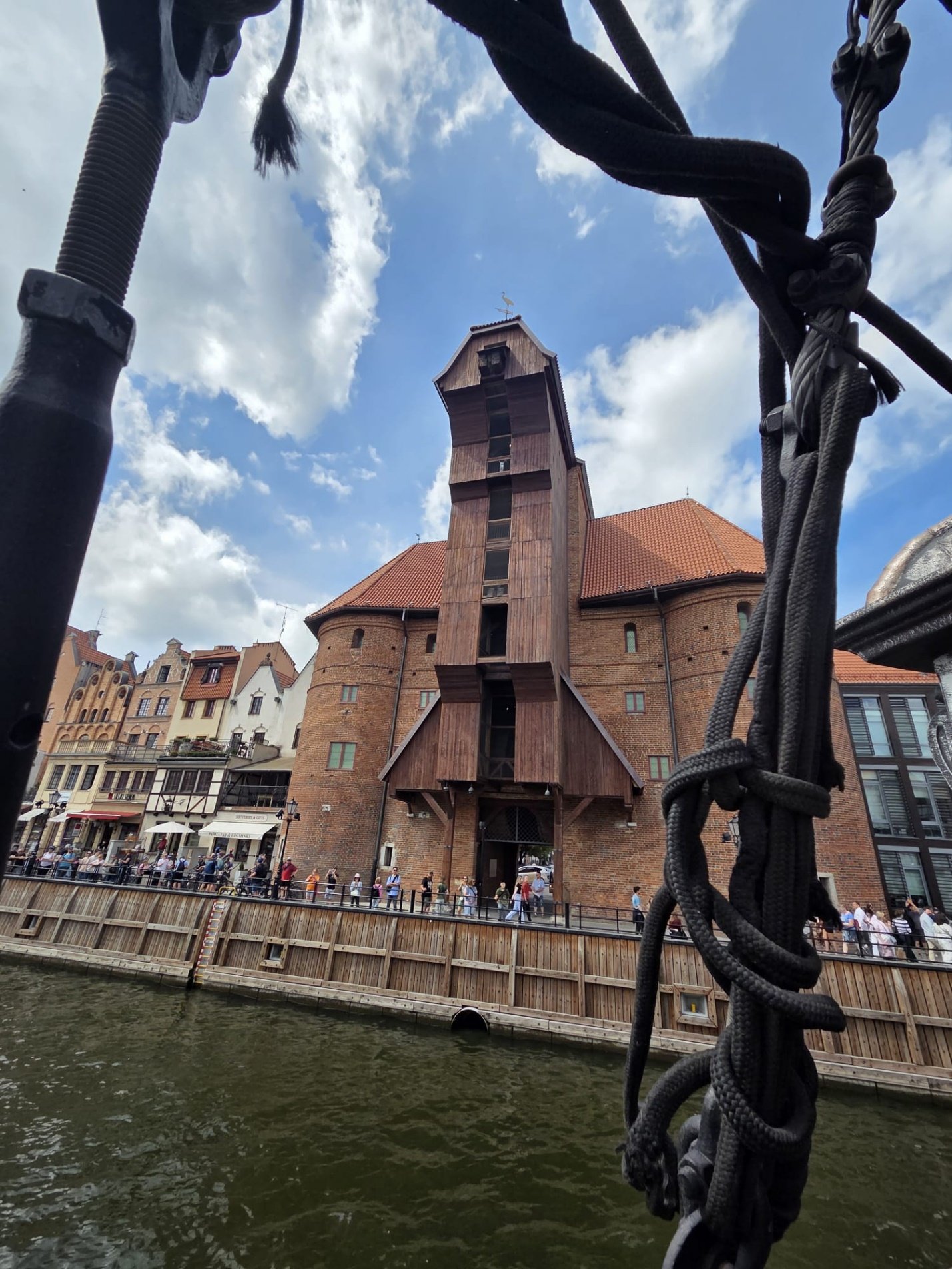
The Gdansk Crane, before and after. This is the oldest preserved port crane in Europe and together with the brick towers, it is one of the so-called water gates of the Main City of Gdansk – the Szeroka Gate. In the central part, between the towers, there is a wooden structure of the lift, composed of two drums with a diameter of 6 m, which were originally driven by people walking on the treadmills inside the drums. The Crane in its present form was built between 1442 and 1444.
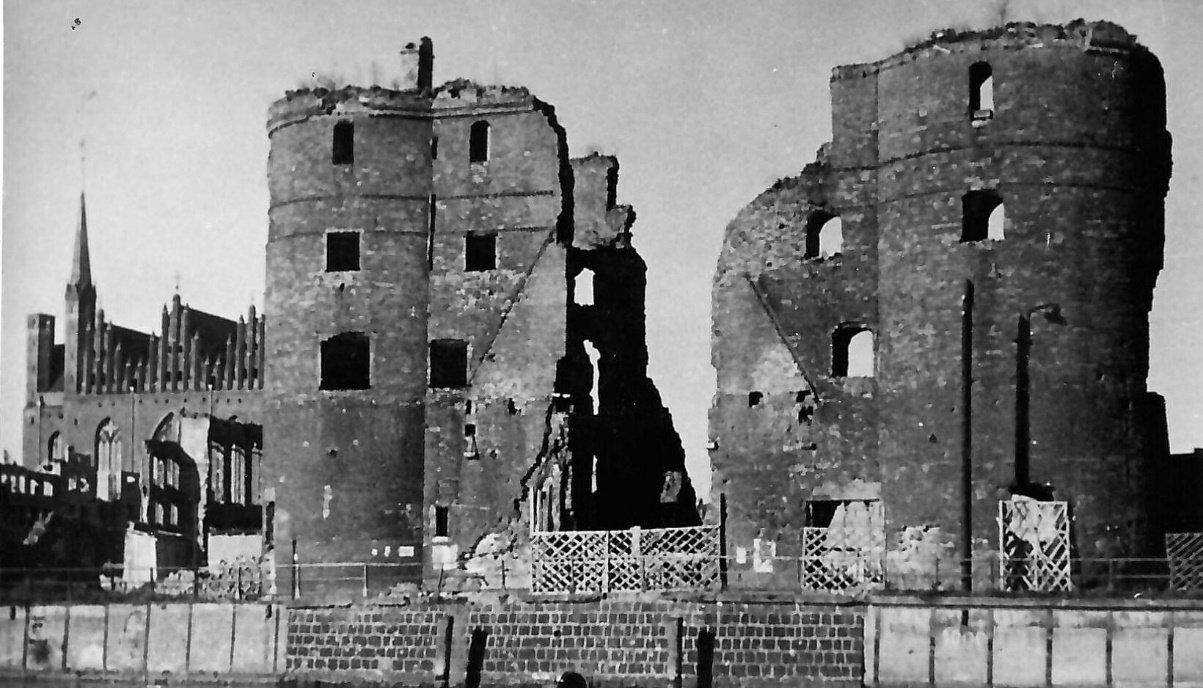
The crane was used for unloading cargo and raising masts on the sailing ships. The current site houses the National Maritime Museum.
The construction St Mary’s Catholic church started in 1379 and was completed in 1502. It is one of the three largest brick churches in the world, the others being in Bologna (which we visited at Easter) and one in Munich. The church holds over 25,000 worshippers.
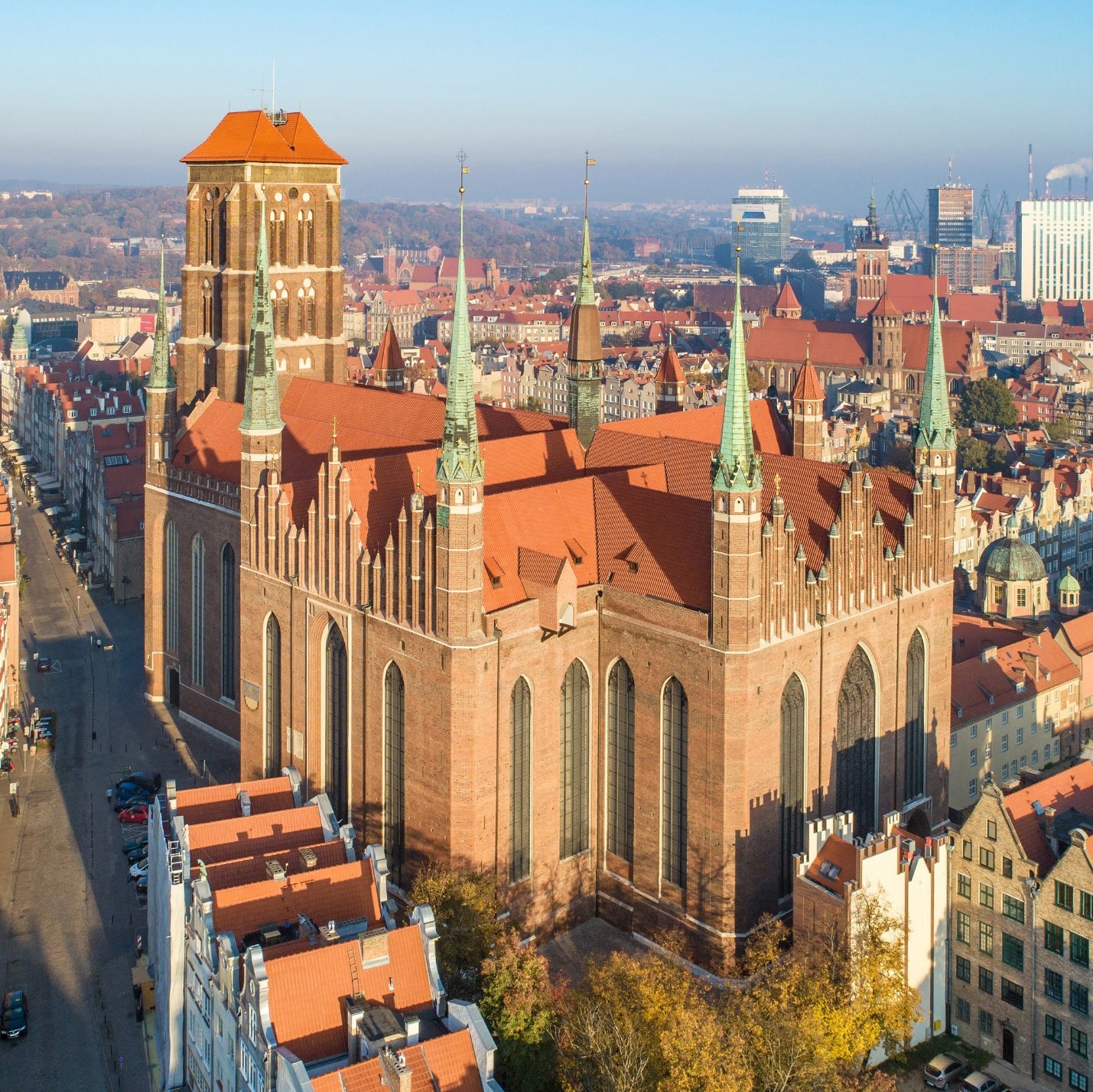
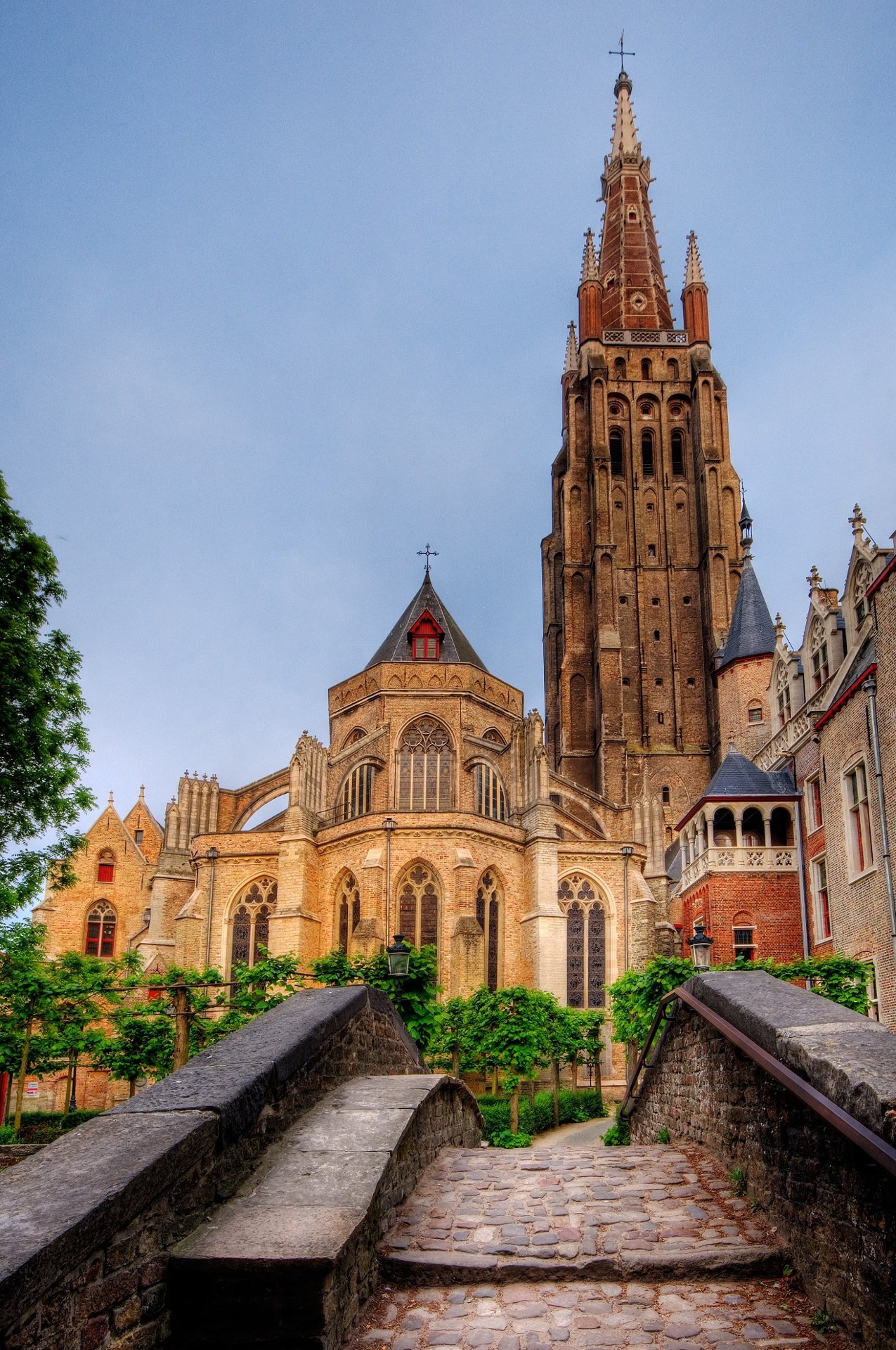
The church design was heavily influenced by St Mary’s Church in Bruges, particularly the design of the tower.
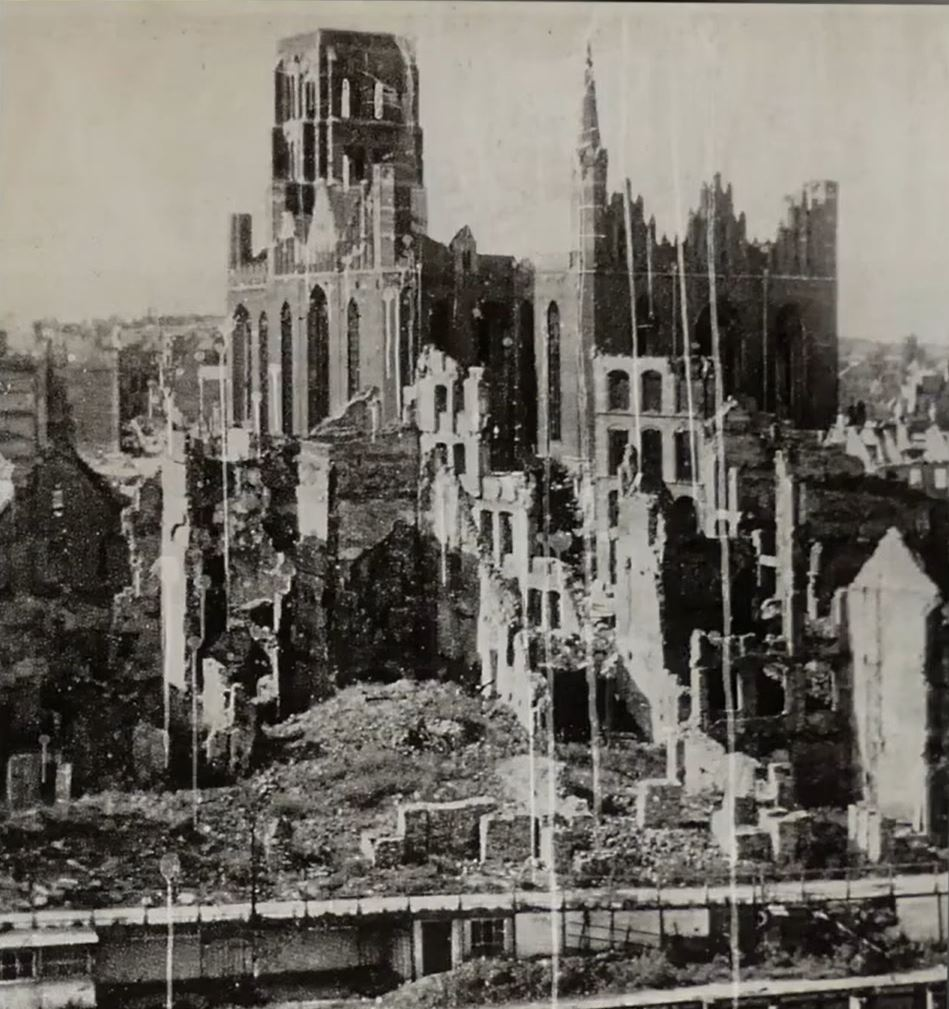
The church was severely damaged late in World War II, the wooden roof burned completely and most of the ceiling fell in. Fourteen of the large vaults collapsed. The windows were destroyed. In places the heat was so intense that some of the bricks melted, especially in the upper parts of the tower, which acted as a giant chimney. All remaining bells crashed down when their bell cages collapsed in the fire. The floor of the church, containing priceless gravestone slabs, was torn apart, allegedly by Soviet soldiers attempting to loot the corpses buried underneath.
Rebirth
As we often do, we went on a walking tour of the city to get our bearings and learn some of the history. I asked the guide, since Poland was under Communist rule after the war, how did the magnificent buildings get so faithfully reproduced. He told me they were Polish Communists, proud of their heritage and determined to wipe out all Germanic influences.
After the war, the ethnic German population was removed and replaced by Polish refugees. There was significant pressure to build simple, Soviet-style concrete blocks, with some Polish officials arguing against rebuilding “monuments to Teutonic Invaders.”
However, in 1948, a compromise was reached, Architects used 17th and 18th-century maps to reconstruct the city. They intentionally selected the more Dutch and Flemish-style designs for facades while completely ignoring the later German-style modifications of the 19th century. Make 1793 (the end of the Polish rule) great again.
Due to these stylistic choices, modern Gdansk appears more “Dutch” today than it did immediately preceding the war. While the interiors of the buildings are often communal living blocks, the exterior facades maintain the historic northern Renaissance aesthetic. If you didn’t know the history, you would think Gdansk was your standard 1000-year-old town.
Buildings
Green Gate
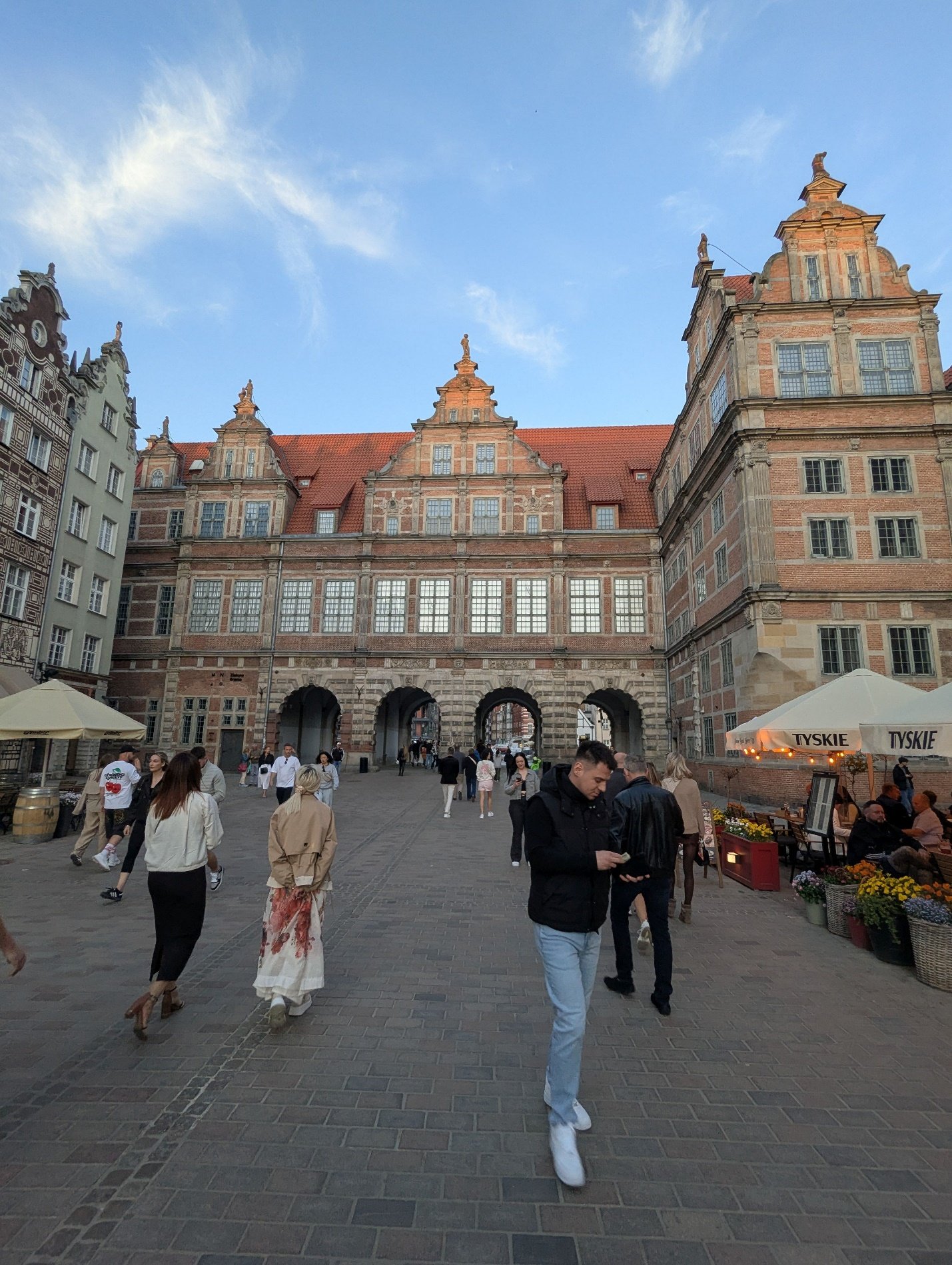
The gates of the city were all magnificent structures so they were rebuilt. The Green Gate is on the Motlawa river and leads to the luxurious Long Market.
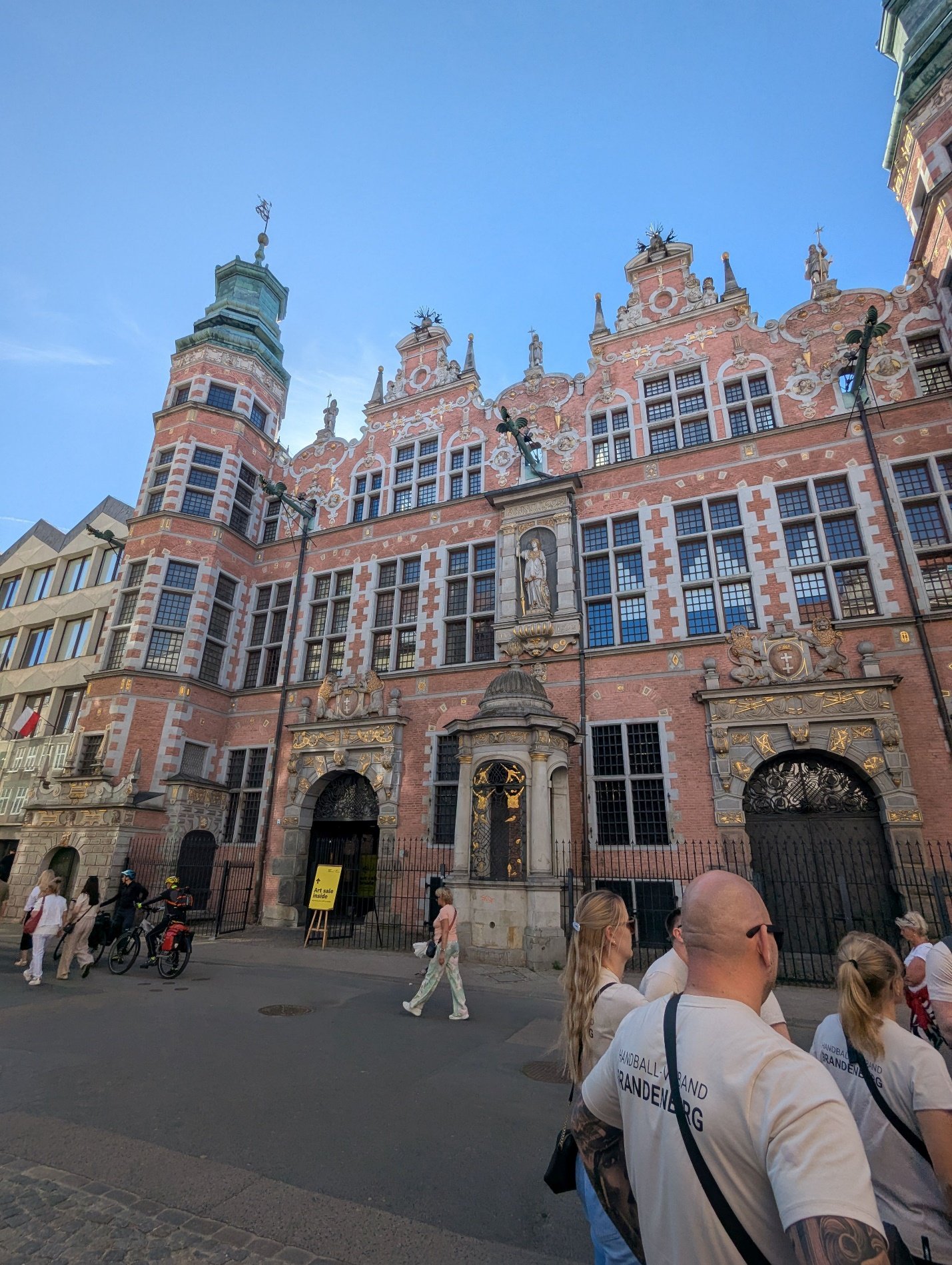
The Armoury was built in 1605 in response to more persistent threats to the city.
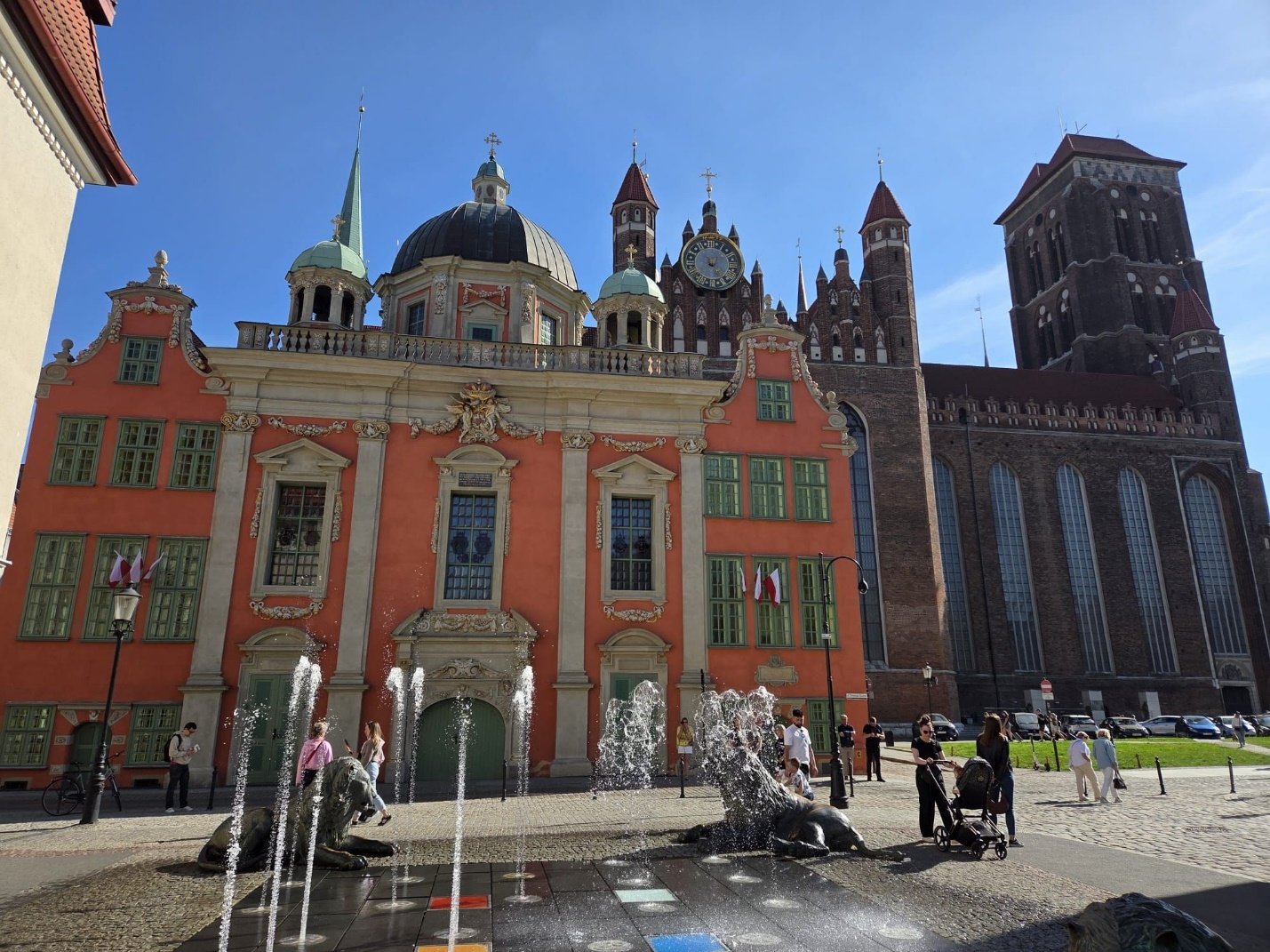
The Royal chapel was built in 1681 to serve the Catholic community in a time where the population was mostly Protestant. St Mary’s in the background.
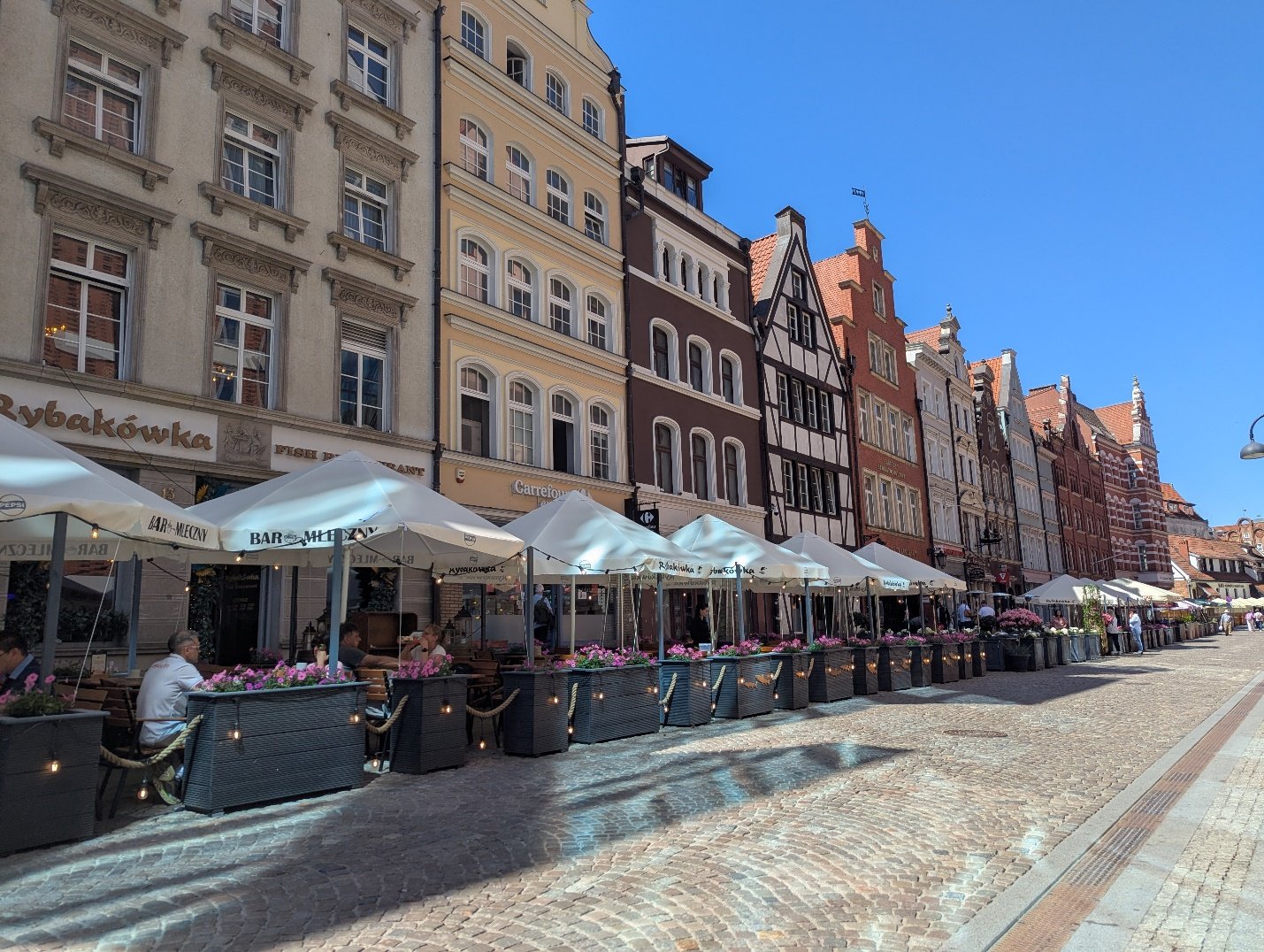
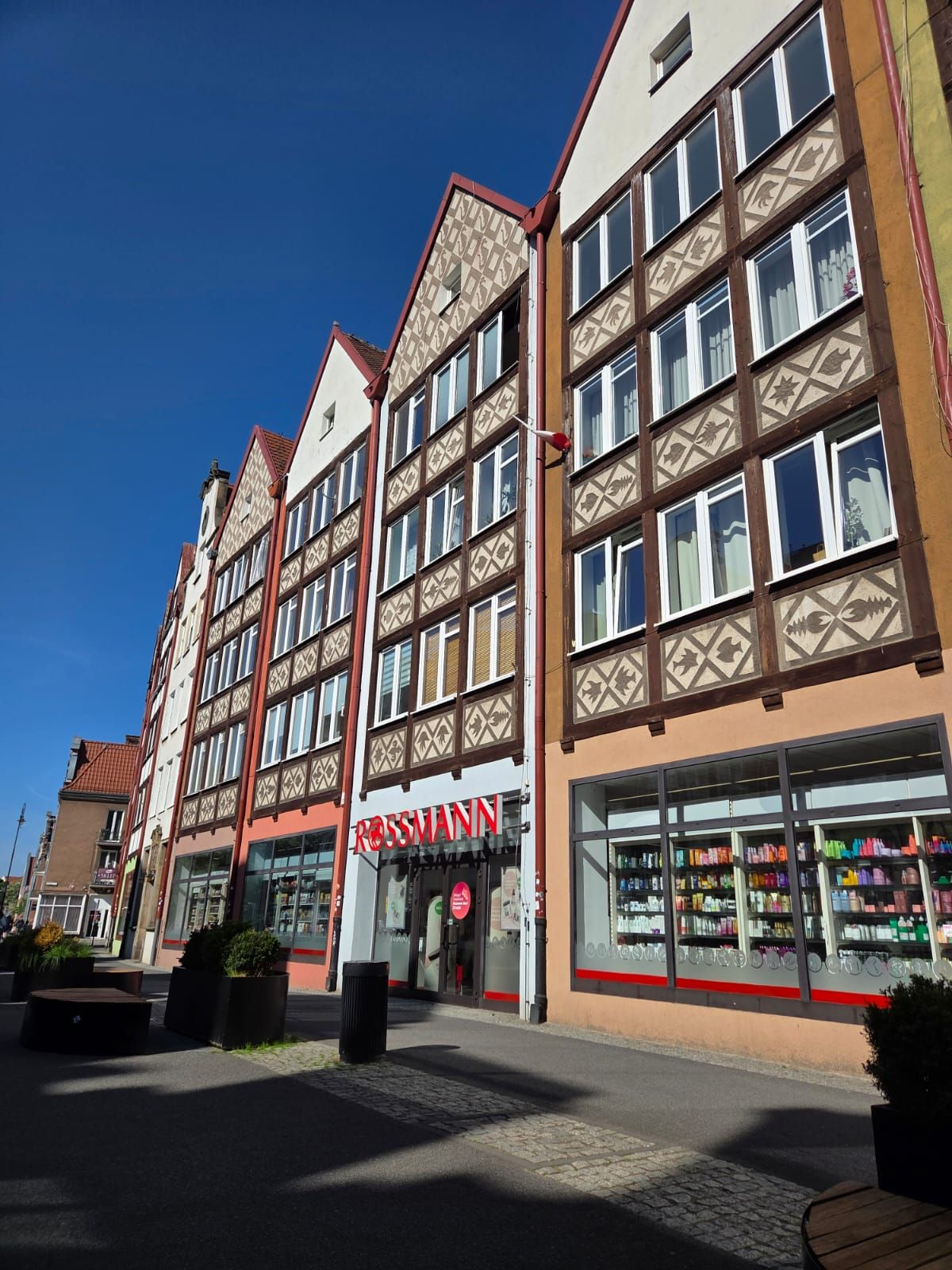
The housing maintained the old facades but were completely rebuilt inside. Many buildings now span multiple modern facades.
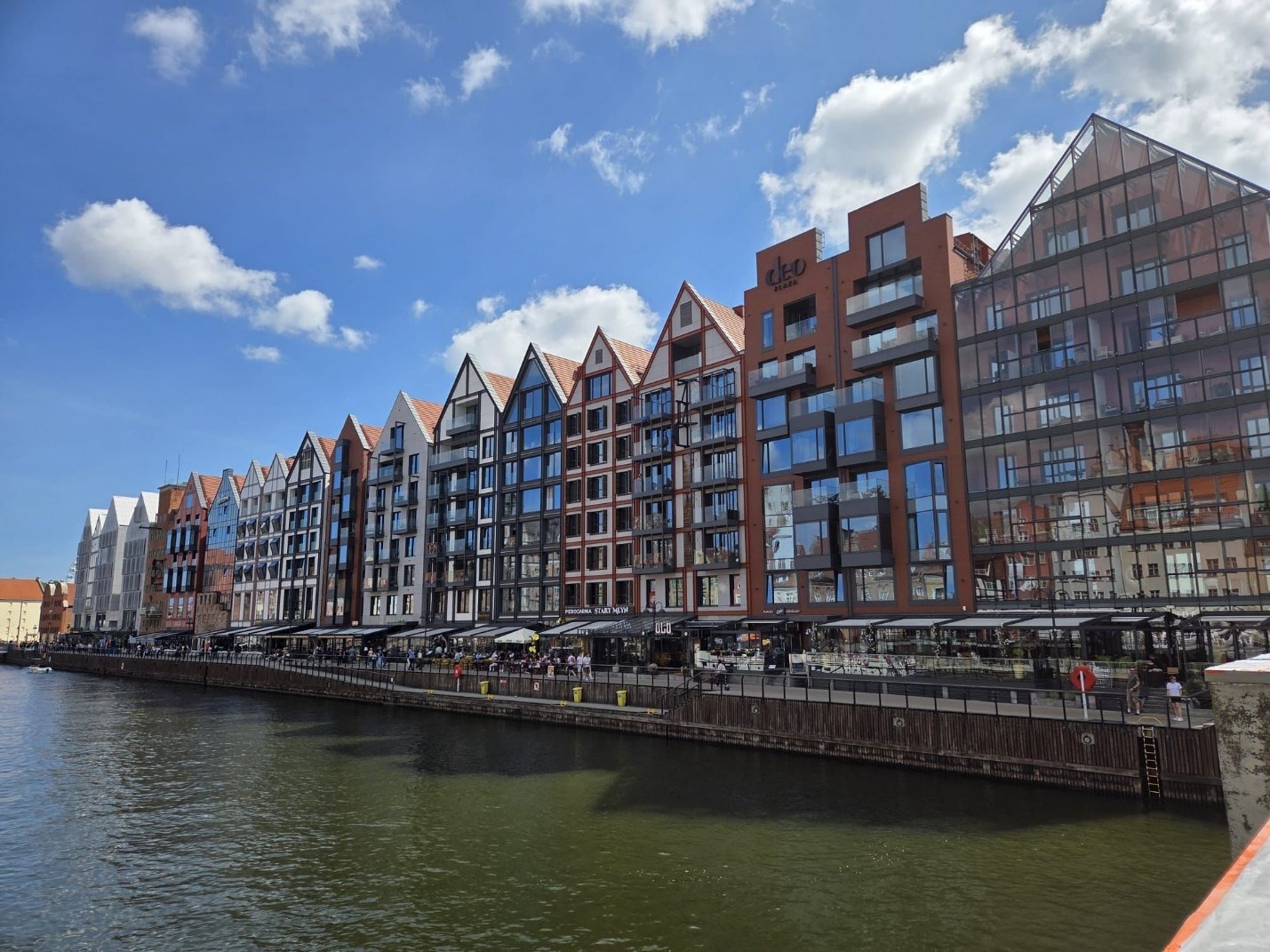
In other areas, particularly along the main Motlawa River that runs through the city, the buildings are made of modern materials with an homage to the past. Bars and restaurants adorn the waterfront.
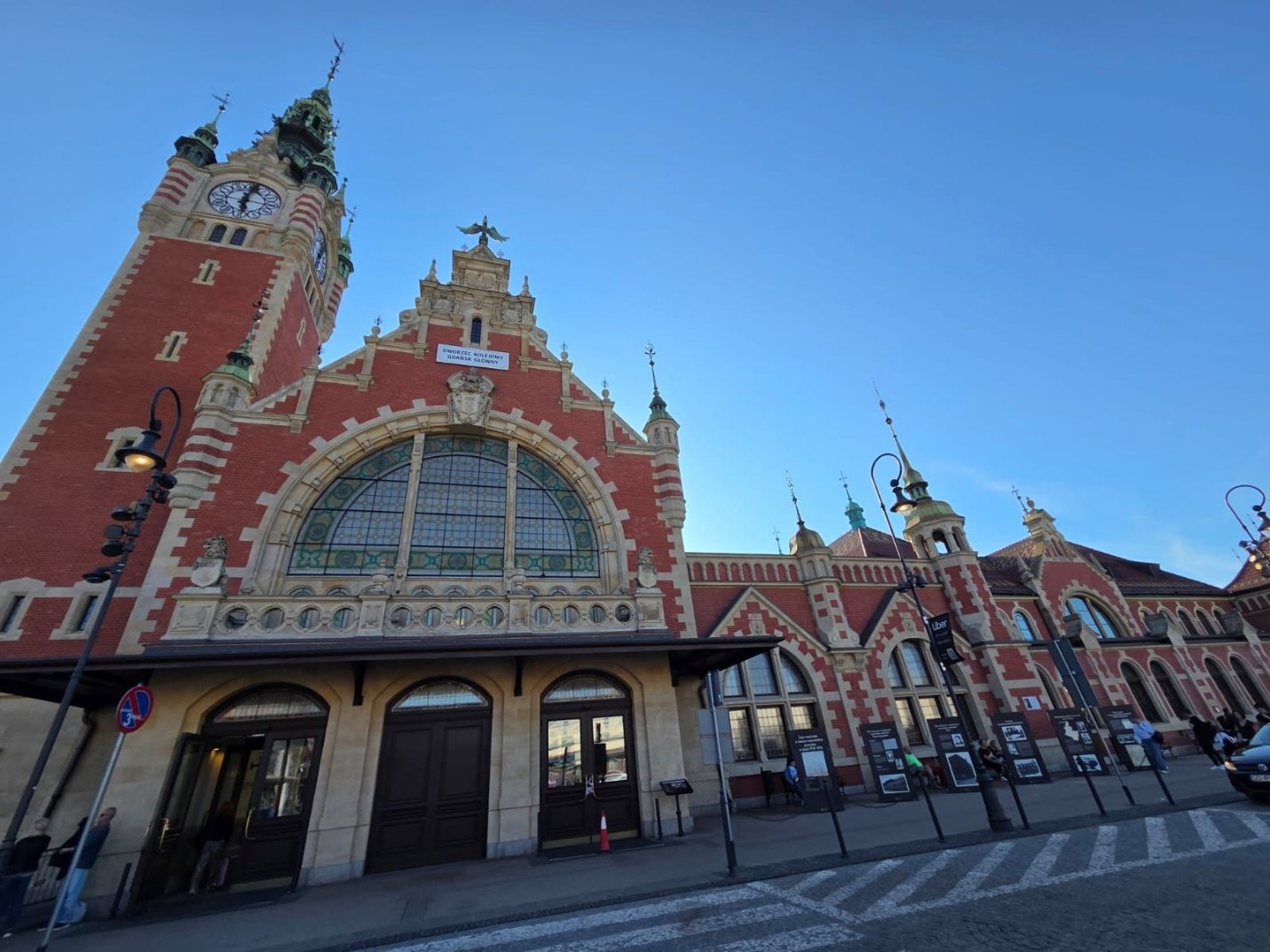
The train station was completed in 1900.
Outside the station is the Children’s Statue. After 1938, Britain agreed to take children from Nazi controlled areas. The memorial is to the children who escaped, the parents who were persecuted and the families that were never reunited. About 100 children left from the Gdansk Station.
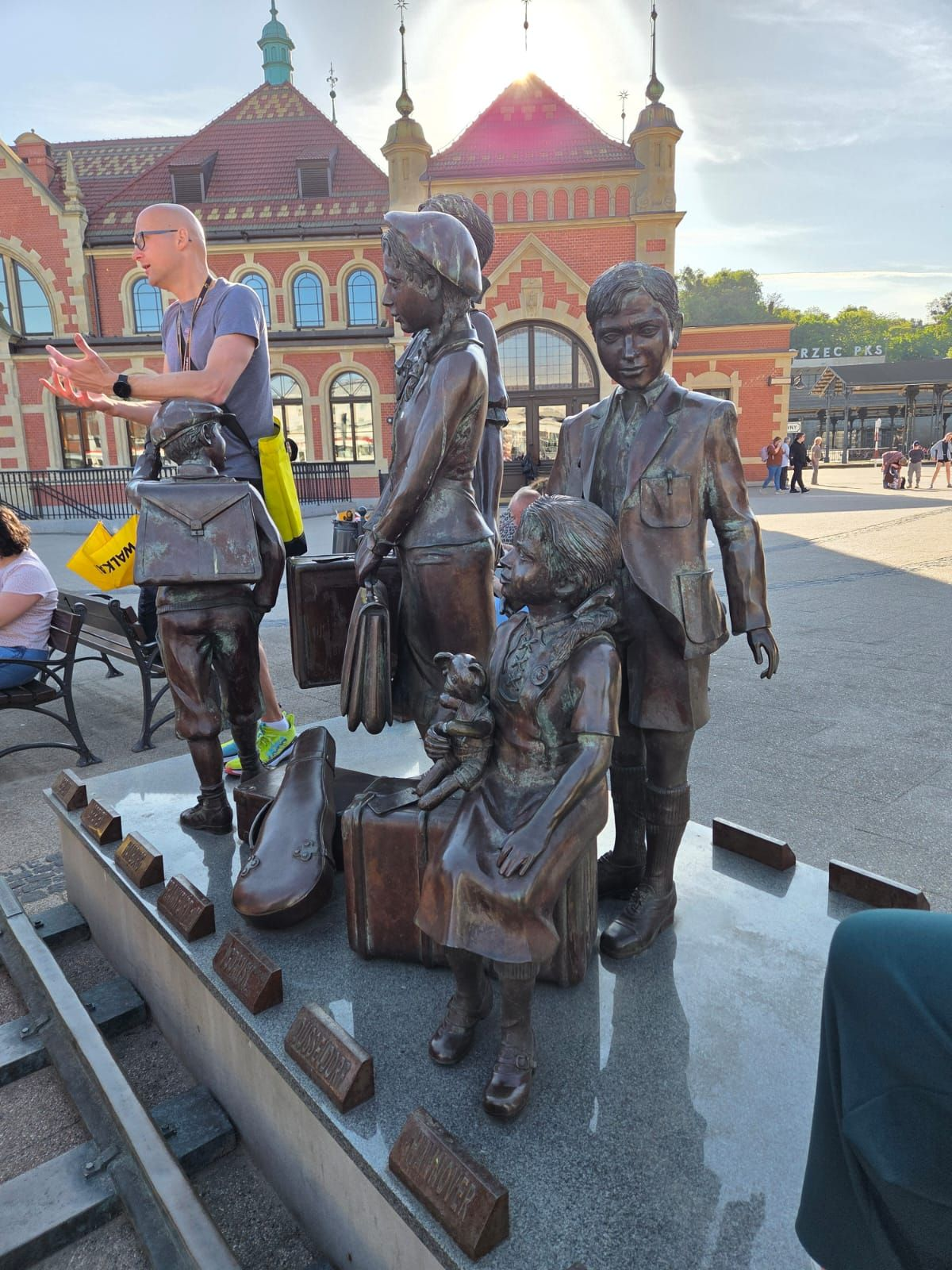
Coincidentally on the flight over to Europe at easter, I watched One Life, the movie that tells the true story of British stockbroker Nicholas Winton, who organized the rescue of 669 predominantly Jewish children from German-occupied Czechoslovakia on the eve of World War II. An excellent movie with a very moving ending where his efforts are finally formally acknowledged.
The Museum of the Second World War
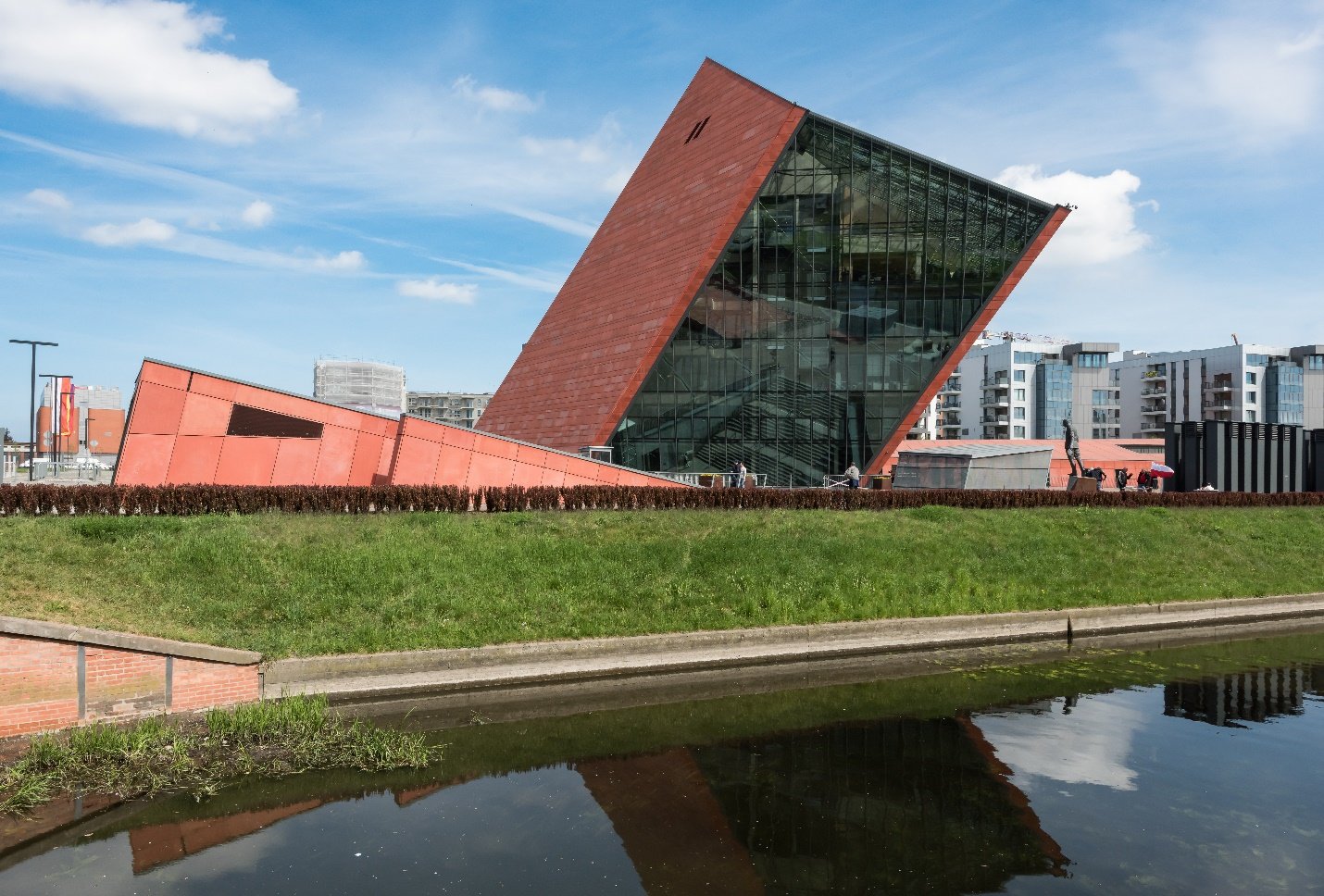
Gdansk’s excellent Museum of the Second World War was open in 2017. The unique building design has the main exhibition space 3 floors underground. The building’s dramatic, tilted, rising form and its division into underground and above‑ground zones symbolize the past buried beneath, the present around us, and the future rising upward.
Through Rachel’s research we got a tour with one of the museum curators, the best way to see the space. His first question was there actually a second world war was disconcerting, but he was making the point that many people feel WW2 was just a continuation of WW1 and that each country defines the start of the war separately. China considers the war started in 1937 when the Japanese invaded, Czechoslovakia in 1938, most of the rest of us in 1939 and the US in 1941.
The museum focused more on the impact of civilians than the individual battles. There was an excellent section of Soviet propaganda, showing the soldier guiding the people to their true home.
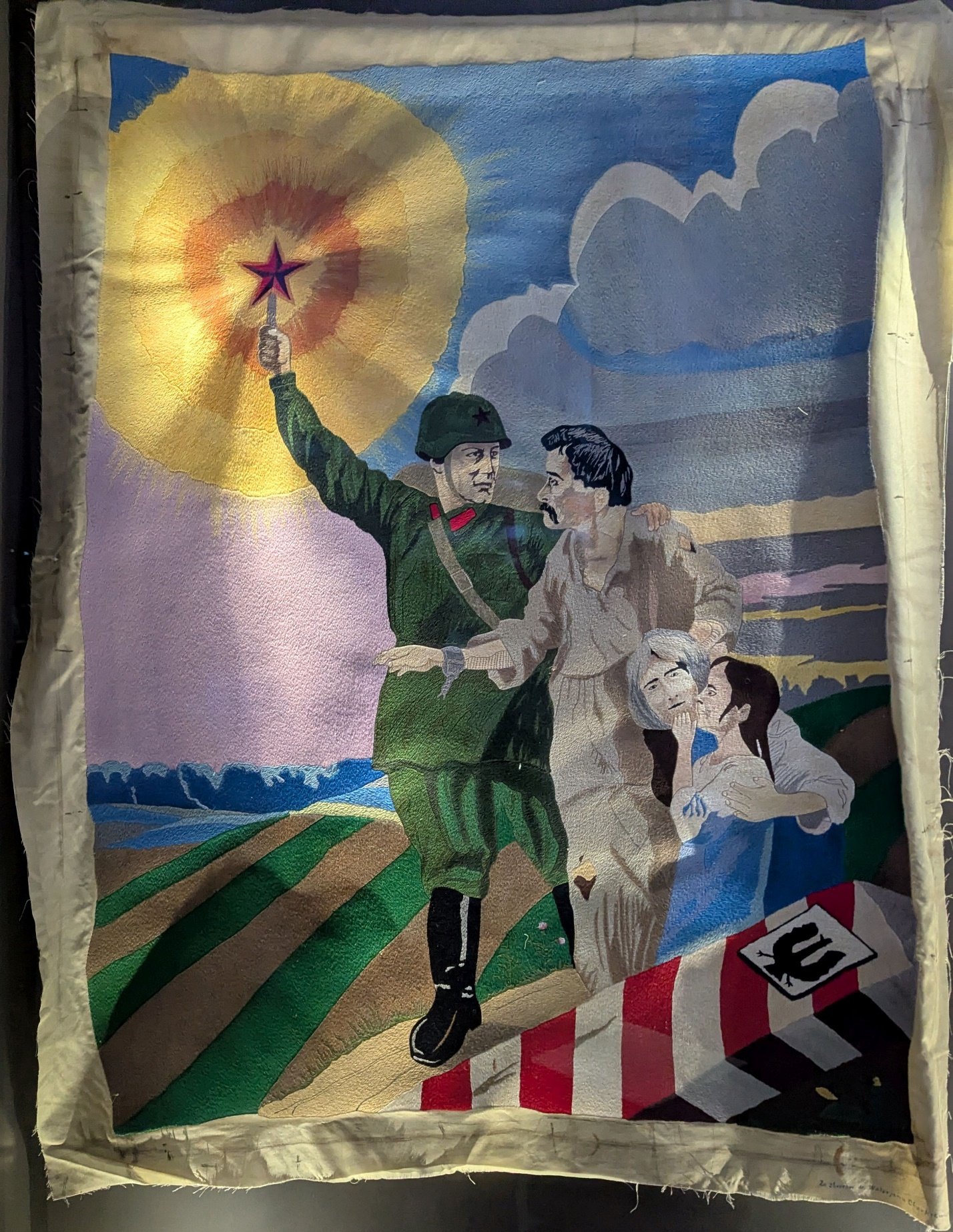
Hundreds of thousands of Poles were shipped off to Siberia where they stayed until 1943. The people who remained were terrorized as the introduction to that section shows.
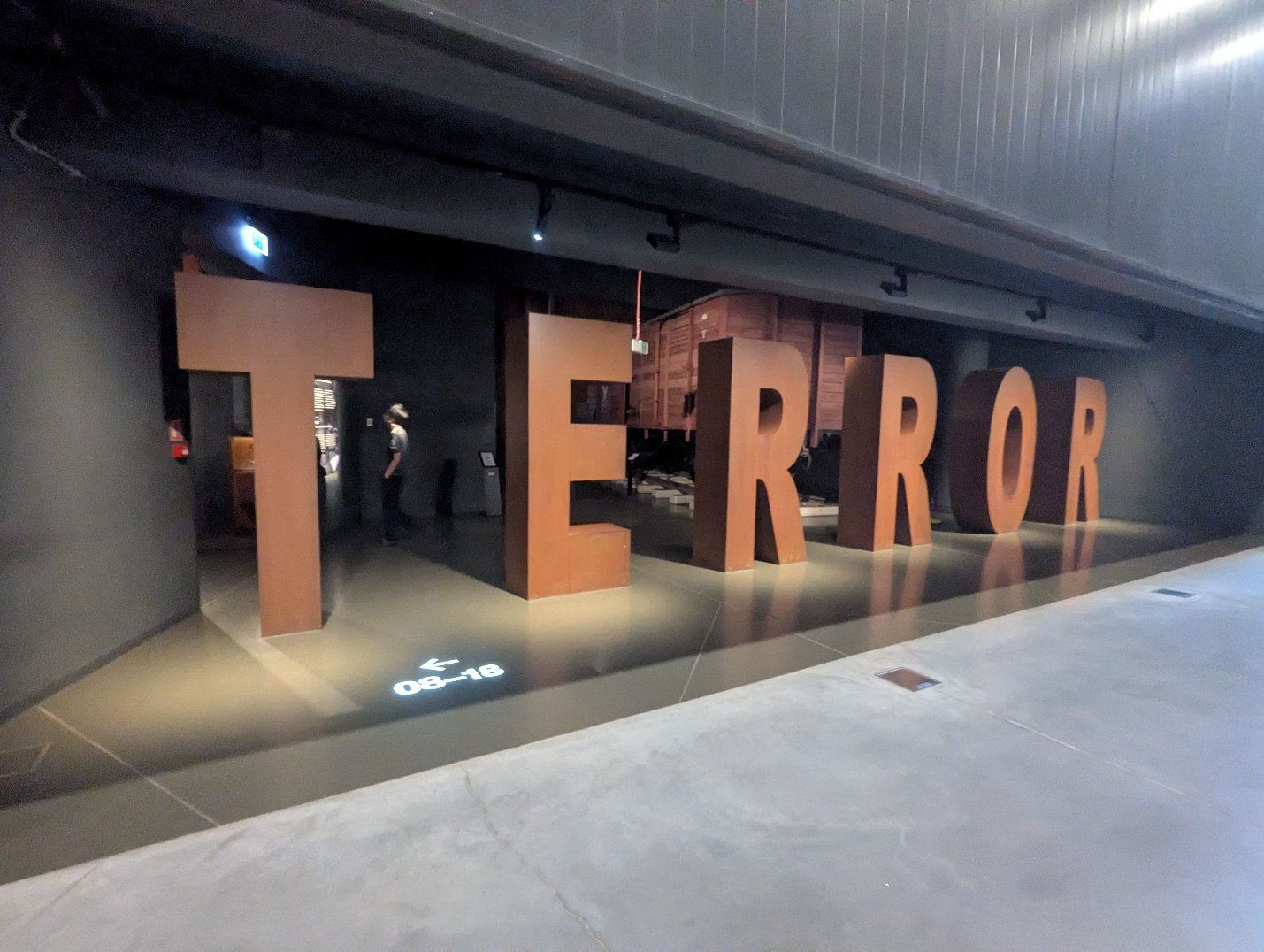
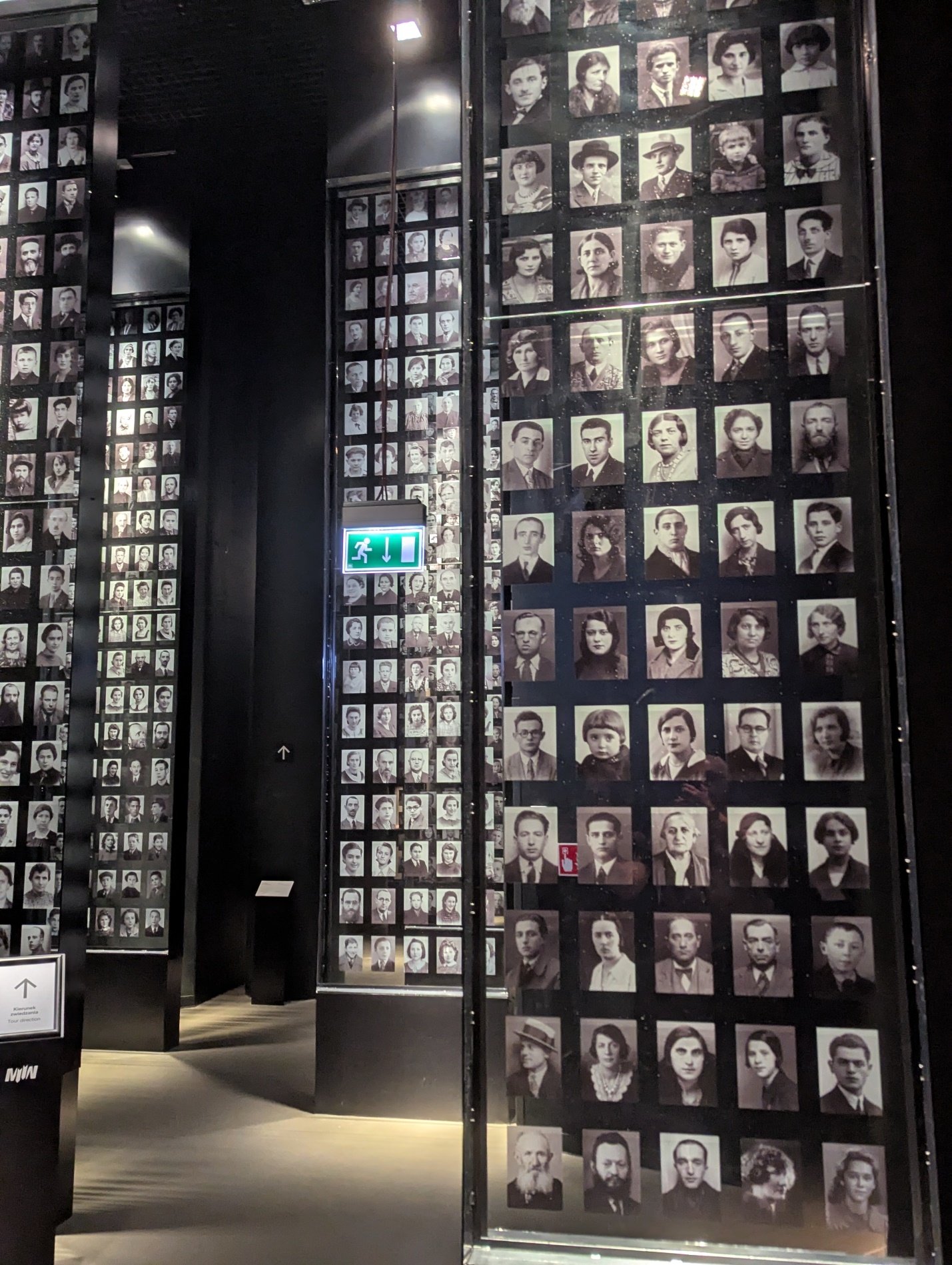
The Holocaust section is stark showing pictures of some of the 6 million people who were executed. An additional 20 million were pressed into forced labour with more than 10 percent of them perishing.
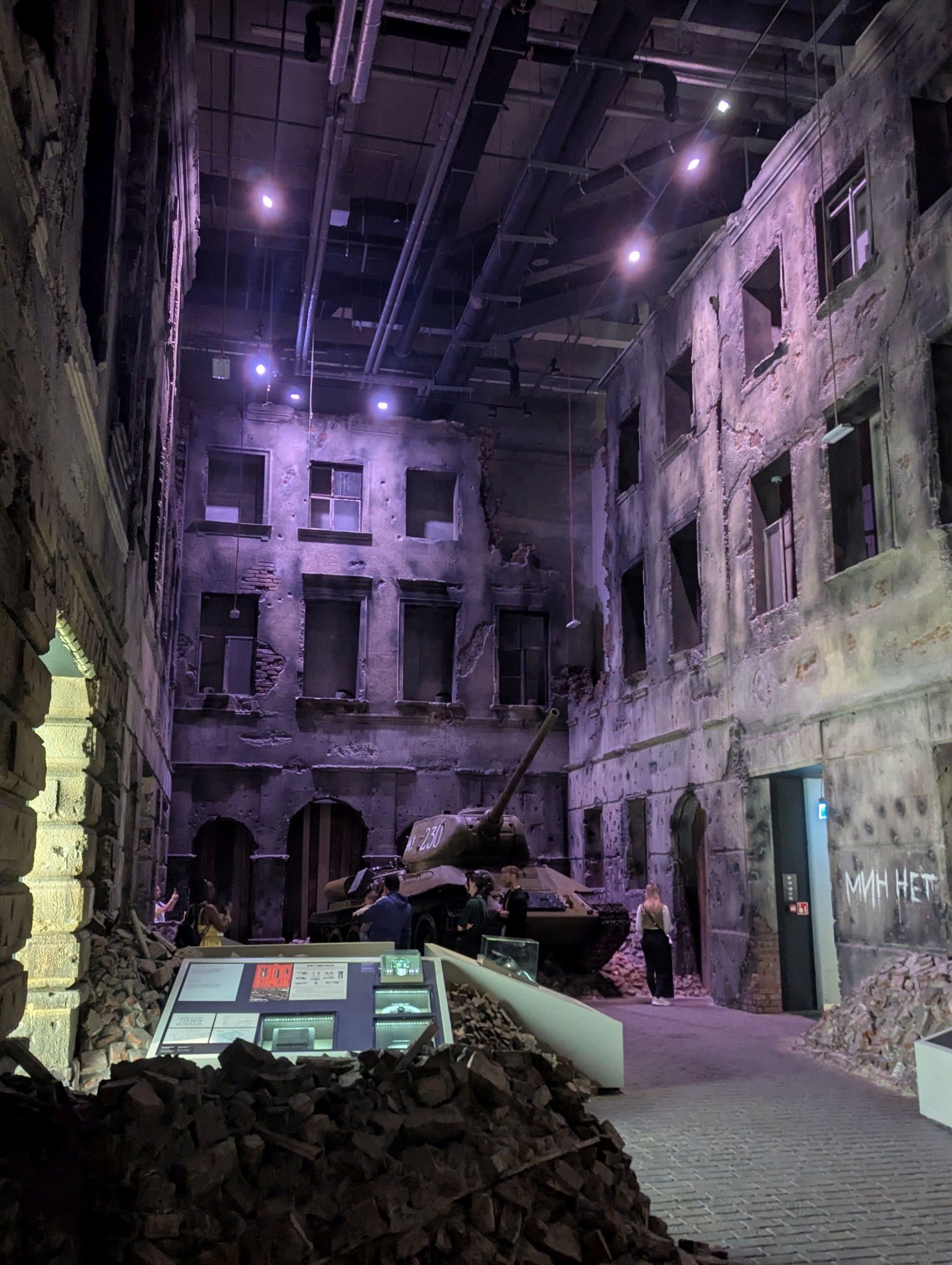
There are chilling representations of life in the occupied cities. A 30-ton tank is 3 stories underground; it was placed in during construction and the museum built around it.
An excellent museum, well worth visiting. They have modern displays, information in Polish and English, a number of short videos that accurately depicted life in the war.
Port Cruise
There are two pirate ships that cruise the port area about a 30-minute one way trip.
Rachel setting the course.
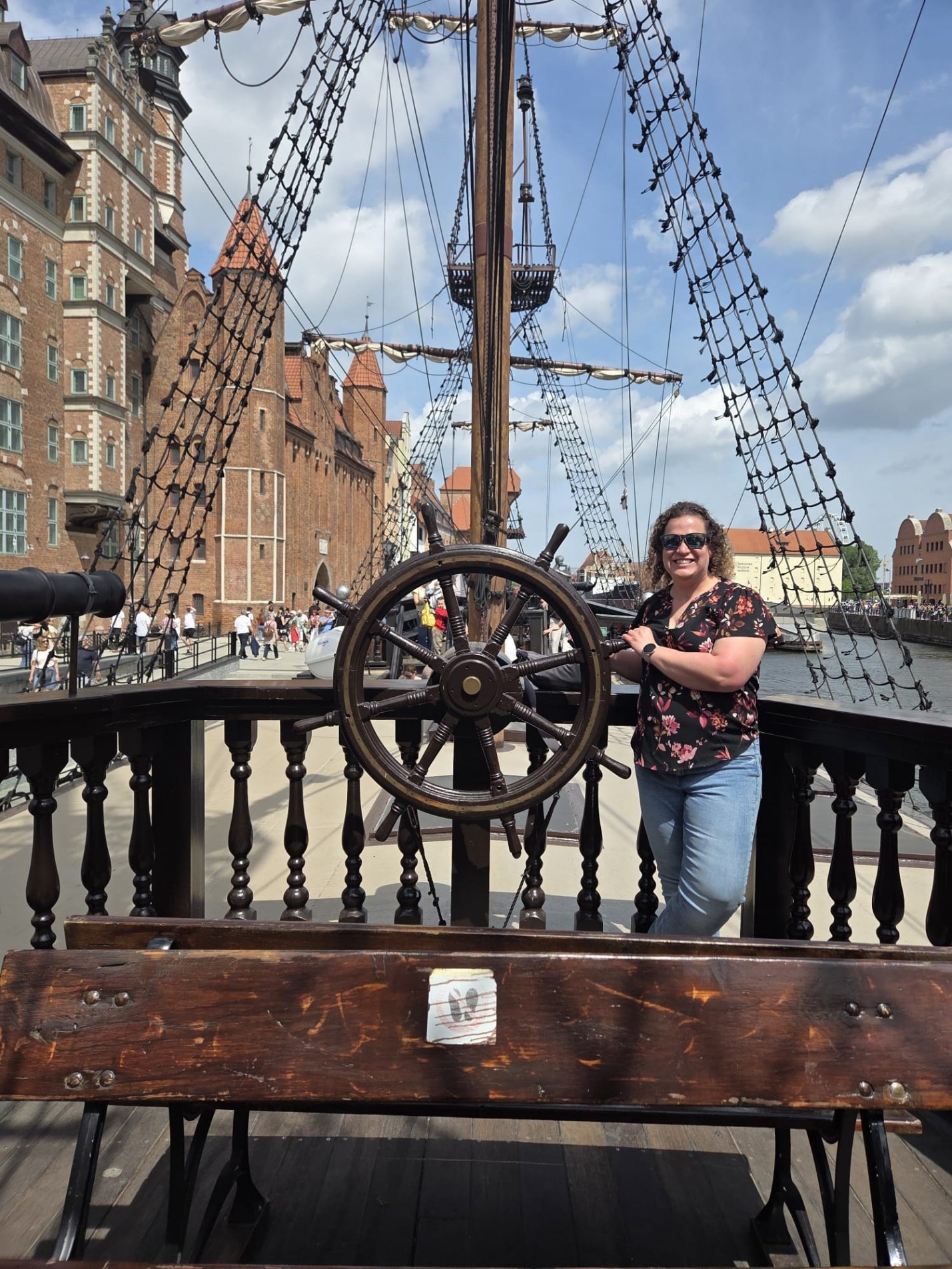
Sailing past the Crane.
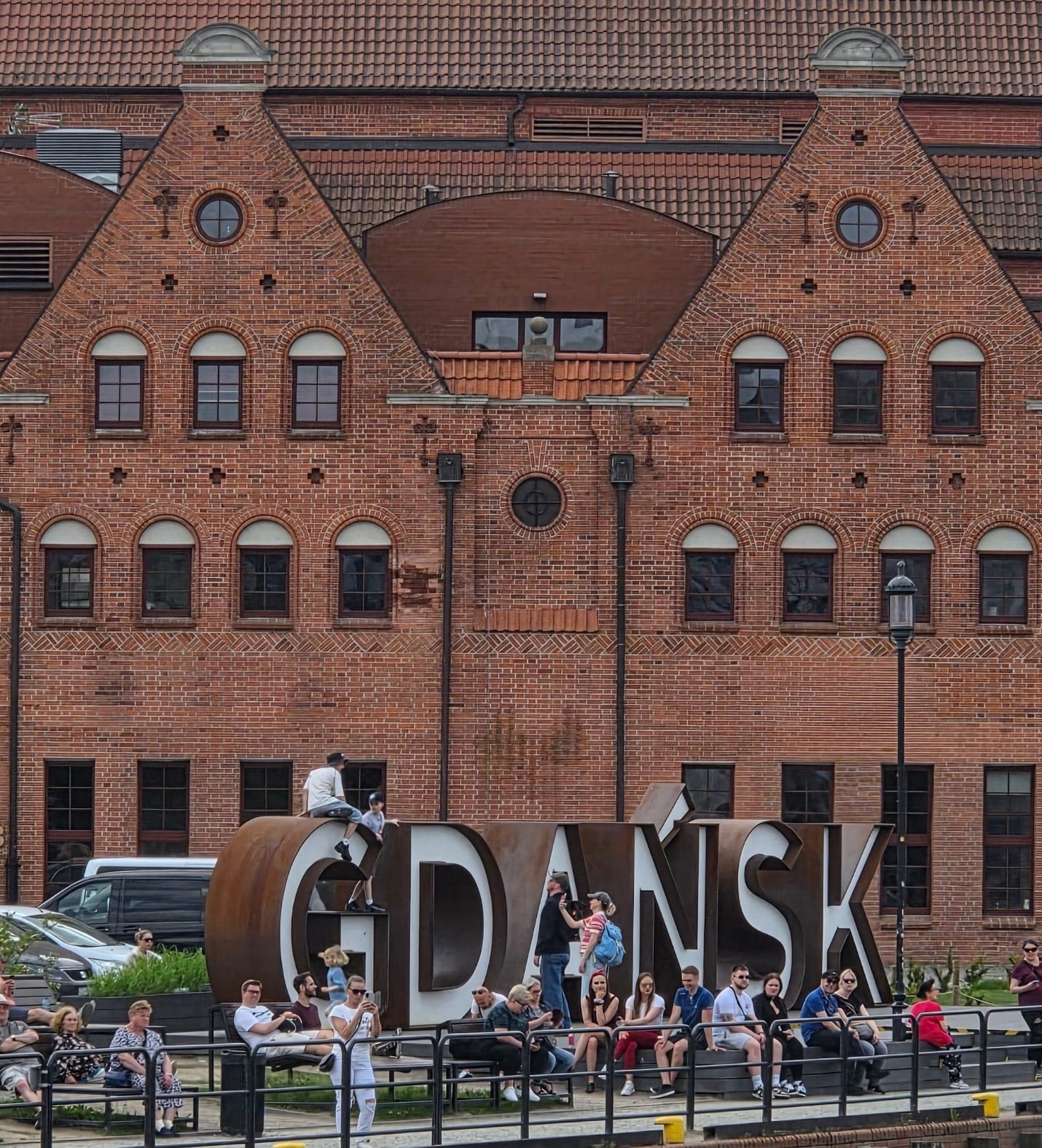
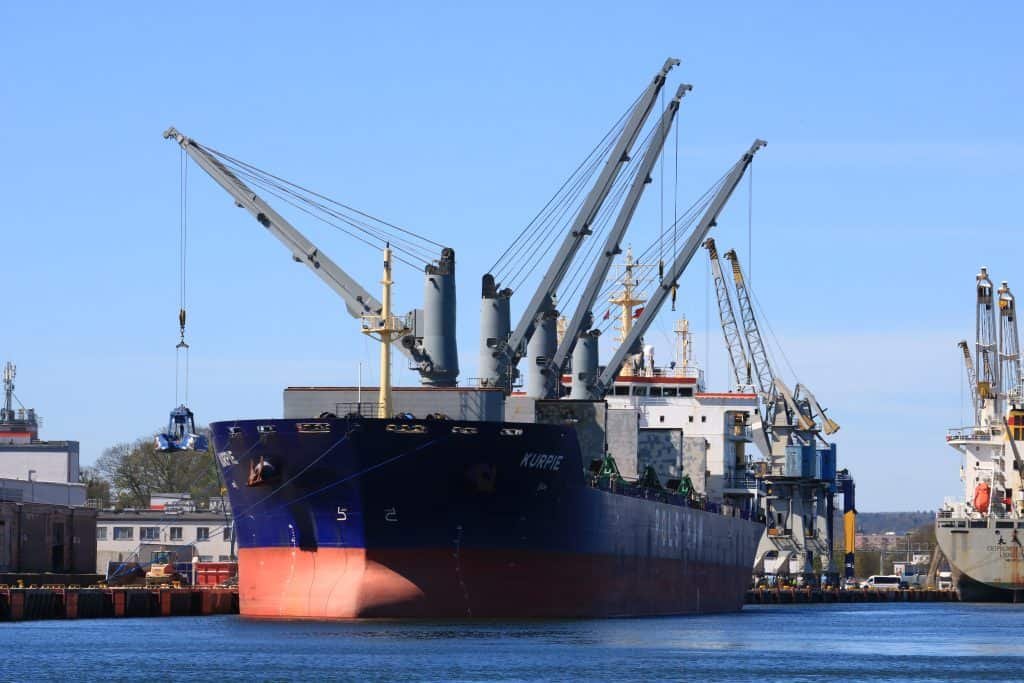
This is a massive harbour with many loading docks for all types of cargo.
Out and About
One of Rachel’s many talents is scoping out the best places to eat and drink. We are perogy fans so we ended up at Pierogarnia Stary Młyn for a baked/traditional combo.
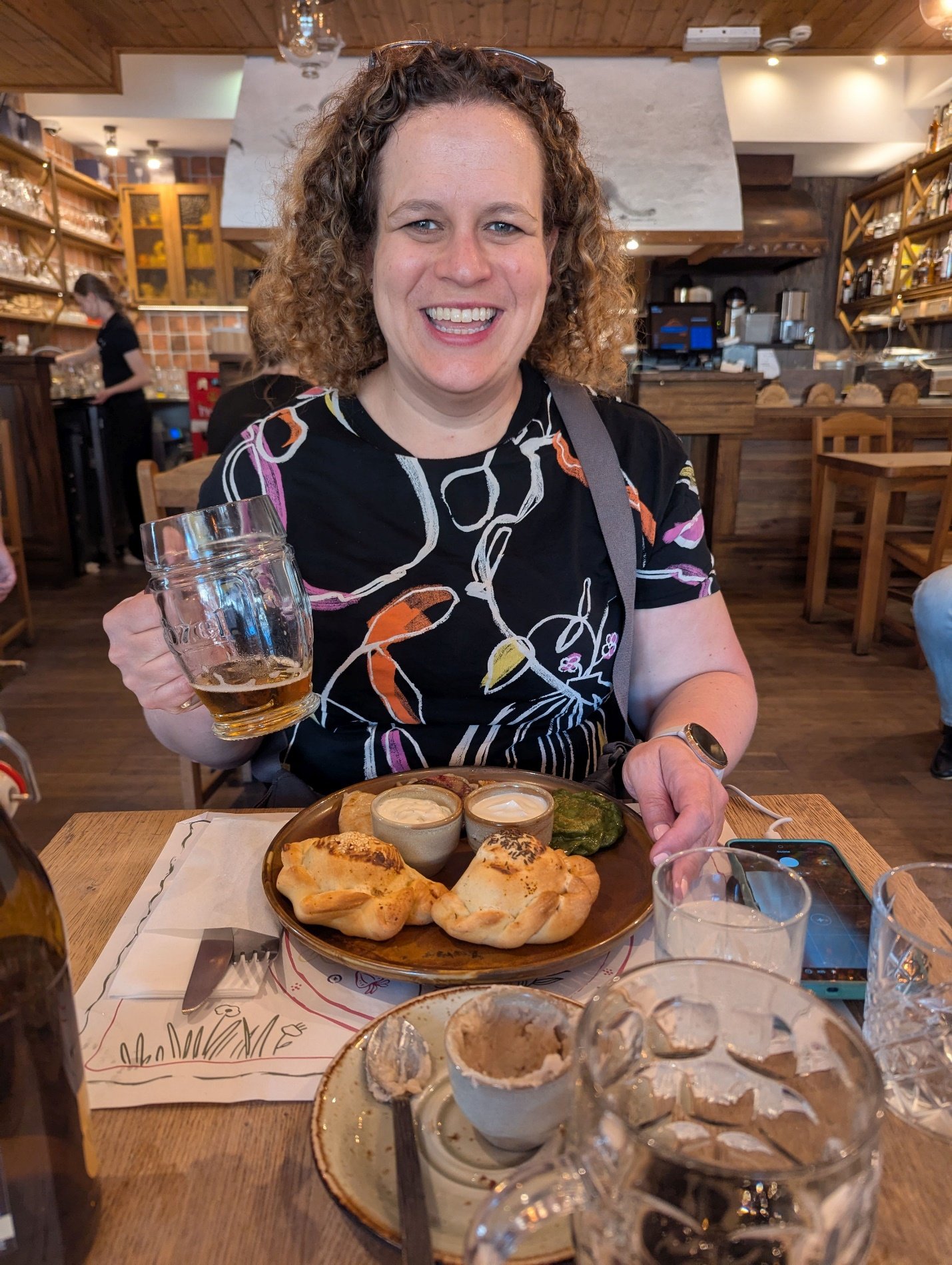
The waiter’s shirt tells the truth.

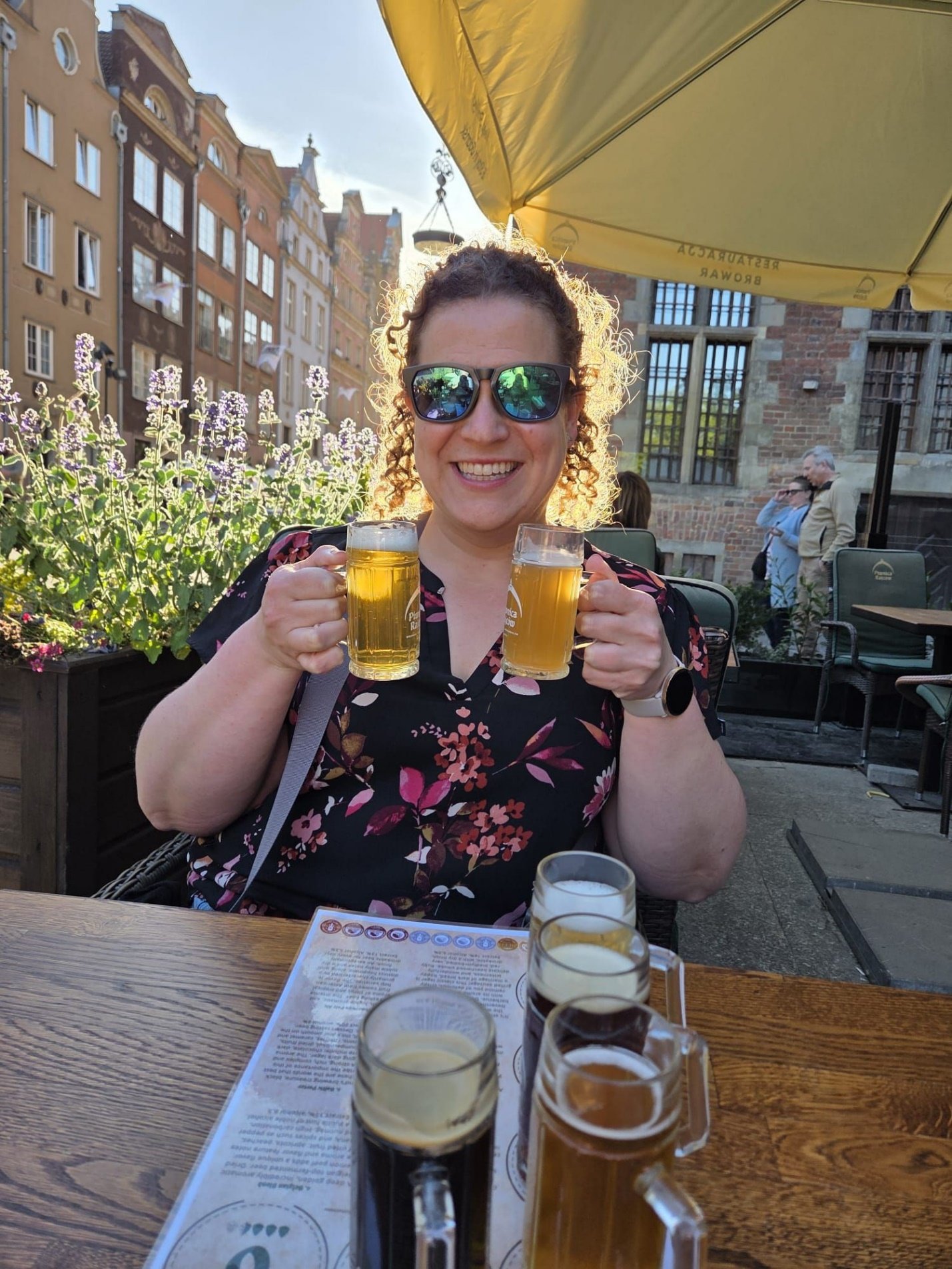
In the shade of Neptune’s fountain Rachel enjoying a flight of excellent Polish beers.
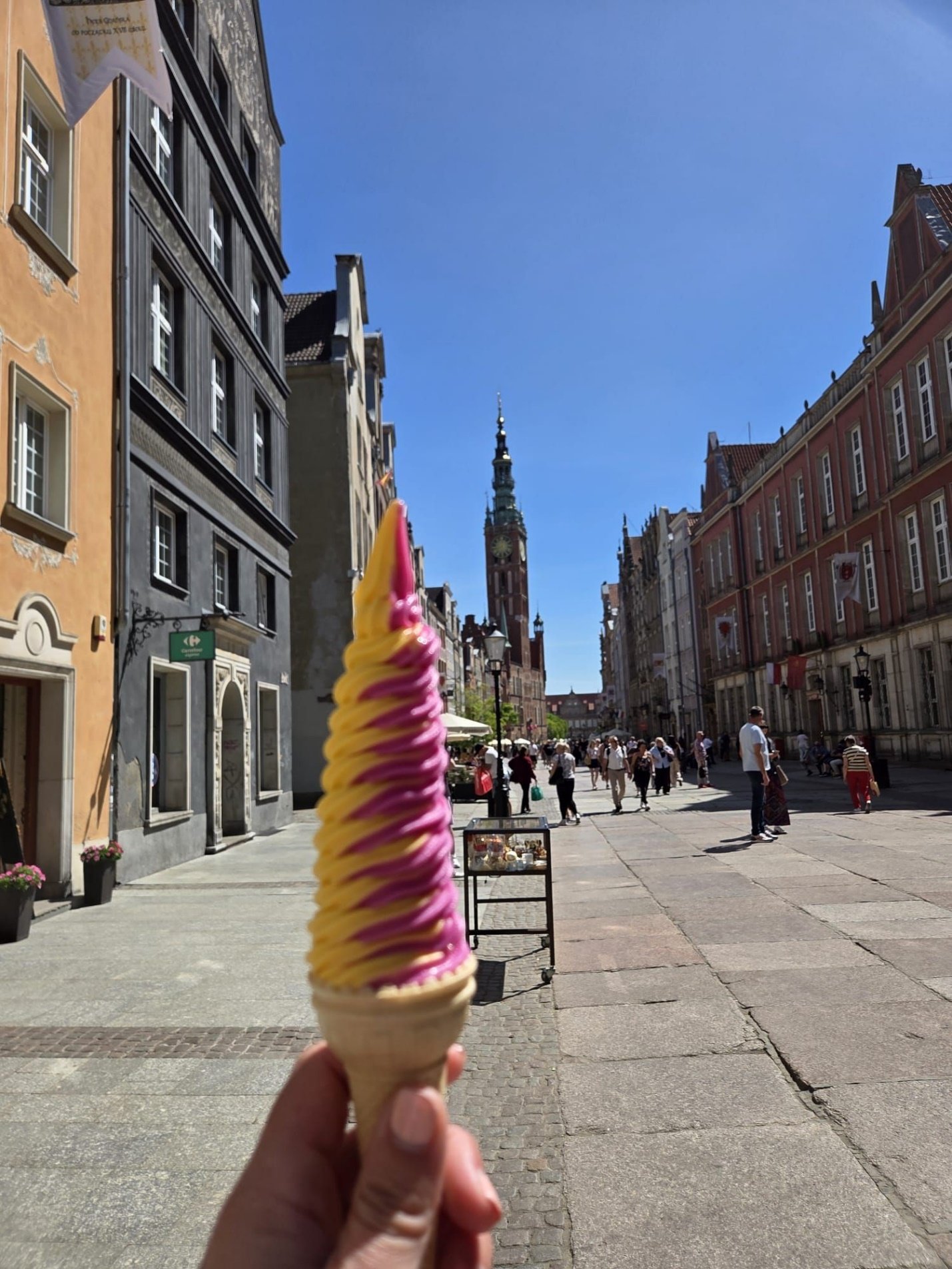
Topping it off with a replica of the Old Town Hall Tower.
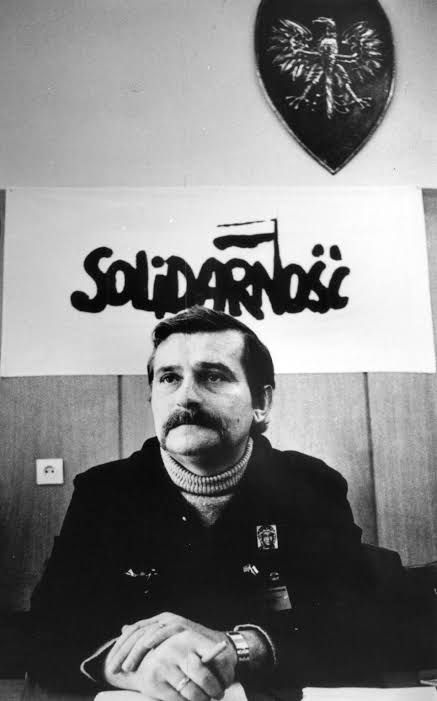
Lech Walesa – Solidarity Movement
The other key event in Gdansk was the formation of the Solidarity Movement that led Poland to embrace democracy and was a key factor in the freedom of many neighbouring countries.
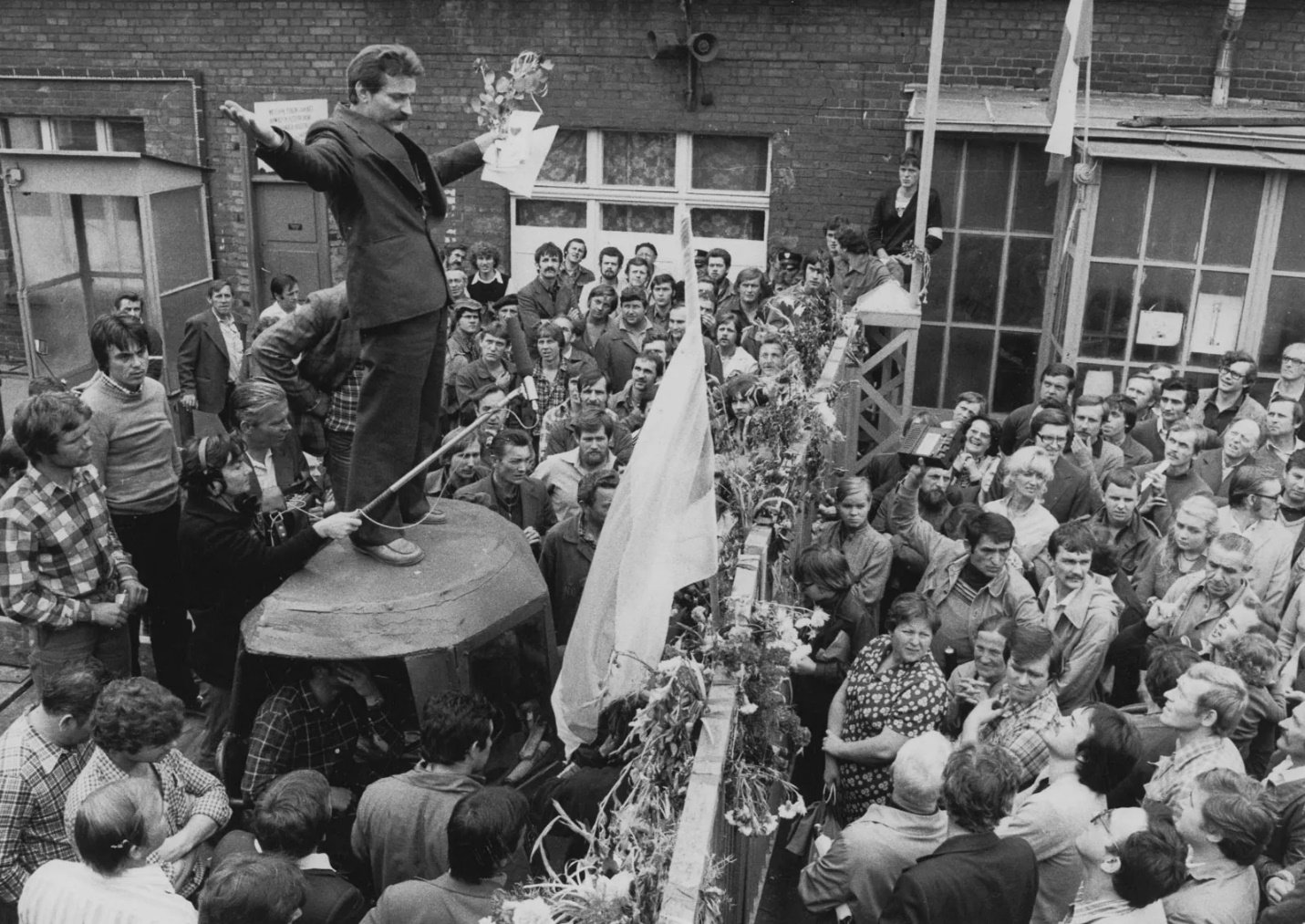
While working at the Lenin Shipyard (now Gdansk Shipyard), Wałęsa, an electrician, became a trade-union activist, for which he was persecuted by the government, placed under surveillance, fired in 1976 and arrested several times. In August 1980, he was instrumental in political negotiations that led to the ground-breaking Gdansk Agreement between striking workers and the government. He co-founded the Solidarity trade union, whose membership rose to more than ten million.
After martial law in Poland was imposed and Solidarity was outlawed, Wałęsa was arrested again. Released from custody, he continued his activism and was prominent in the establishment of the Round Table Agreement that led to the semi-free 1989 Polish parliamentary election and a Solidarity-led government. He presided over Poland’s transition from Marxist–Leninist state socialism into a market-based liberal democracy for 6 years, winning the Nobel Peace Prize.
Final Thoughts
Gdansk was a remarkable city, filled with magnificent buildings and a rich history. I was fascinated with the rebuilding process and how a country under communist rule was able to recreate the city so faithfully. It was evident that Polish Pride ran much deeper than their politics. I’ve spent a great deal of time in Ypres and Arras, two cities that faithfully recreated their city centres after World War One. In those cases, the city inhabitants returned determined to rebuild their lives. In the case of Gdansk, by the start of the war, the population was 90% German and those that remained were deported after the war, so Gdansk was an empty city and the Poles who moved in afterwards did not have ties to the city’s history.
I’d highly recommend a visit. Our only regret was that a long weekend was not nearly long enough to explore the rich culture and history of this vibrant city.